The 2026 Hyundai Santa Cruz is one of the most distinctive compact pickups available today. It combines the everyday comfort of an SUV with the practicality of an open cargo bed, giving buyers an alternative to both conventional SUVs and larger pickup trucks.
Unlike traditional body-on-frame pickups, the Santa Cruz uses a unibody construction and shares its basic architecture with Hyundai’s SUV lineup. That approach gives it a more car-like driving experience while still providing useful towing, cargo and all-wheel-drive capabilities.
For 2026, the Santa Cruz is offered in five trims: SE, SEL, SEL Activity, XRT and Limited. The lower trims use a 191-horsepower 2.5-liter four-cylinder engine, while the XRT and Limited receive a 281-horsepower turbocharged 2.5-liter engine. HTRAC all-wheel drive is available on the lower trims and standard on the XRT and Limited.
The 2026 model also benefits from a conventional eight-speed automatic transmission on the turbocharged XRT and Limited trims, replacing the previous eight-speed dual-clutch transmission.
2026 Hyundai Santa Cruz Highlights
| Feature | 2026 Hyundai Santa Cruz |
|---|---|
| Starting MSRP | $29,750 |
| Seating capacity | 5 |
| Base engine | 2.5L 4-cylinder |
| Base horsepower | 191 hp |
| Turbo engine | 2.5L turbo 4-cylinder |
| Turbo horsepower | 281 hp |
| Turbo torque | 311 lb-ft |
| Transmission | 8-speed automatic |
| Drivetrain | FWD or HTRAC AWD |
| Maximum towing | 5,000 lbs |
| Bed length | 52.1 inches |
| Bed volume | 27.0 cu. ft. |
| Maximum EPA highway rating | 30 mpg |
| Infotainment screen | 12.3 inches |
| Seating | 5 |
| Warranty | 5 years/60,000 miles basic; 10 years/100,000 miles powertrain |
Hyundai’s published specifications and pricing are for the U.S. market and exclude freight, taxes, title, registration and other applicable charges.
What Is the Hyundai Santa Cruz?
The Hyundai Santa Cruz is a compact pickup designed for people who want some of the utility of a truck without moving into a larger, more traditional pickup.
It has a five-passenger cabin, an open cargo bed and available all-wheel drive. Its relatively compact footprint also makes it more suitable for everyday urban driving than many midsize and full-size pickups.
The concept is straightforward: use an SUV-like platform and driving character, then add a pickup bed.
That makes the Santa Cruz particularly relevant to buyers who carry bicycles, camping equipment, gardening supplies, tools, sports equipment or other bulky items but do not need a heavy-duty work truck.
The Santa Cruz is also more than a lifestyle vehicle. The turbocharged versions can tow up to 5,000 pounds, while the standard engine is rated for up to 3,500 pounds when properly equipped.
2026 Hyundai Santa Cruz Price
The 2026 Hyundai Santa Cruz starts at $29,750 in the United States before freight, taxes, registration and other charges. Hyundai offers five trim levels.
| Trim | Starting MSRP* | Engine | Drivetrain |
|---|---|---|---|
| SE | $29,750 | 2.5L 4-cylinder, 191 hp | FWD standard, AWD available |
| SEL | $31,400 | 2.5L 4-cylinder, 191 hp | FWD standard, AWD available |
| SEL Activity | $34,450 | 2.5L 4-cylinder, 191 hp | FWD standard, AWD available |
| XRT | $41,350 | 2.5L turbo, 281 hp | AWD standard |
| Limited | $43,700 | 2.5L turbo, 281 hp | AWD standard |
*Hyundai’s listed MSRP excludes freight, tax, title and license fees. Actual dealer pricing can vary.
The large price difference between the SEL Activity and XRT is important. The XRT is not simply a better-equipped version of the same powertrain. It moves to the more powerful turbocharged engine and standard AWD.
2026 Hyundai Santa Cruz Engine and Performance
The Santa Cruz is available with two 2.5-liter four-cylinder engines.
The standard engine produces 191 horsepower and 181 lb-ft of torque. It is used in the SE, SEL and SEL Activity.
The turbocharged engine produces 281 horsepower and 311 lb-ft of torque and is standard in the XRT and Limited.
| Specification | 2.5L Naturally Aspirated | 2.5L Turbo |
|---|---|---|
| Engine | 2.5L 4-cylinder | 2.5L turbo 4-cylinder |
| Horsepower | 191 hp | 281 hp |
| Torque | 181 lb-ft | 311 lb-ft |
| Main trims | SE, SEL, SEL Activity | XRT, Limited |
| Transmission | 8-speed automatic | 8-speed automatic |
| AWD | Available | Standard |
The difference is substantial.
The standard engine is adequate for everyday commuting and normal highway use. The turbocharged engine, however, gives the Santa Cruz a considerably stronger performance character.
Car and Driver recorded 6.0 seconds from 0 to 60 mph for a turbocharged Limited during its testing.
That is quick for a practical compact pickup and makes the turbo version particularly appealing to buyers who regularly carry passengers or cargo, tow a trailer or simply want stronger acceleration.
2026 Hyundai Santa Cruz Transmission
One of the notable changes for 2026 is the transmission used with the turbocharged engine.
The XRT and Limited previously used an eight-speed dual-clutch transmission. For 2026, Hyundai replaced it with a conventional eight-speed automatic transmission.
This is an important distinction for shoppers comparing model years.
The conventional automatic is also consistent with the Santa Cruz’s focus as an everyday utility vehicle rather than a performance-oriented crossover.
Fuel Economy and MPG
Fuel economy varies substantially depending on the engine and drivetrain.
The most efficient configuration is the front-wheel-drive SE, SEL or SEL Activity, rated at 22 mpg city, 30 mpg highway and 25 mpg combined by the EPA.
AWD versions of those trims are rated at 21/29/24 mpg.
The turbocharged XRT and Limited are rated at 18/25/20 mpg.
| Configuration | City | Highway | Combined |
|---|---|---|---|
| 2.5L FWD | 22 mpg | 30 mpg | 25 mpg |
| 2.5L AWD | 21 mpg | 29 mpg | 24 mpg |
| Turbo AWD | 18 mpg | 25 mpg | 20 mpg |
These are EPA estimates. Actual mileage will depend on traffic, weather, driving style, load, tire pressure and other conditions.
Interestingly, Car and Driver recorded 30 mpg at 75 mph in its highway fuel-economy test of a turbocharged Santa Cruz. That is a controlled real-world test and should not be confused with the official EPA combined rating.
Hyundai Santa Cruz Towing Capacity
Towing is one of the areas where the Santa Cruz becomes more useful than a typical compact SUV.
The standard engine can tow up to 3,500 pounds, while the turbocharged models can tow up to 5,000 pounds when properly equipped.
| Version | Maximum Towing Capacity |
|---|---|
| 2.5L standard engine | 3,500 lbs |
| 2.5L turbo engine | 5,000 lbs |
The 5,000-pound rating puts the turbocharged Santa Cruz in the same maximum towing territory as the Honda Ridgeline and certain Ford Maverick configurations.
That does not make the Santa Cruz a heavy-duty pickup. Its strength is versatility rather than maximum work capacity.
Santa Cruz Cargo Bed
The cargo bed is arguably the feature that makes the Santa Cruz different from a normal SUV.
The bed measures 52.1 inches long, 19.2 inches deep and up to 53.9 inches wide. Between the wheel wells, the width is 42.7 inches.
Hyundai lists the bed volume at 27 cubic feet.
| Cargo-bed measurement | 2026 Santa Cruz |
|---|---|
| Length | 52.1 in |
| Depth | 19.2 in |
| Maximum width | 53.9 in |
| Width between wheel wells | 42.7 in |
| Cargo volume | 27.0 cu. ft. |
The bed is relatively short compared with conventional pickups, but it is designed around everyday usability.
Depending on trim and equipment, buyers can get features such as a retractable tonneau cover, tie-down points, underfloor storage and a 115-volt power inverter.
For camping equipment, bicycles, gardening supplies, tools or weekend projects, this can be more useful than an enclosed SUV cargo compartment.
2026 Hyundai Santa Cruz Dimensions
The Santa Cruz remains relatively compact for a pickup.
| Dimension | Measurement |
|---|---|
| Length | 195.7 in |
| XRT length | 195.9 in |
| Width | 75.0 in |
| Height | 66.7 in |
| Wheelbase | 118.3 in |
| Bed length | 52.1 in |
Hyundai’s official measurements show that the Santa Cruz has a 118.3-inch wheelbase and is 75 inches wide excluding the side mirrors.
Its size is one reason it works well as an everyday vehicle. It is still a substantial vehicle, but it does not have the bulk associated with many traditional pickups.
Interior and Passenger Space
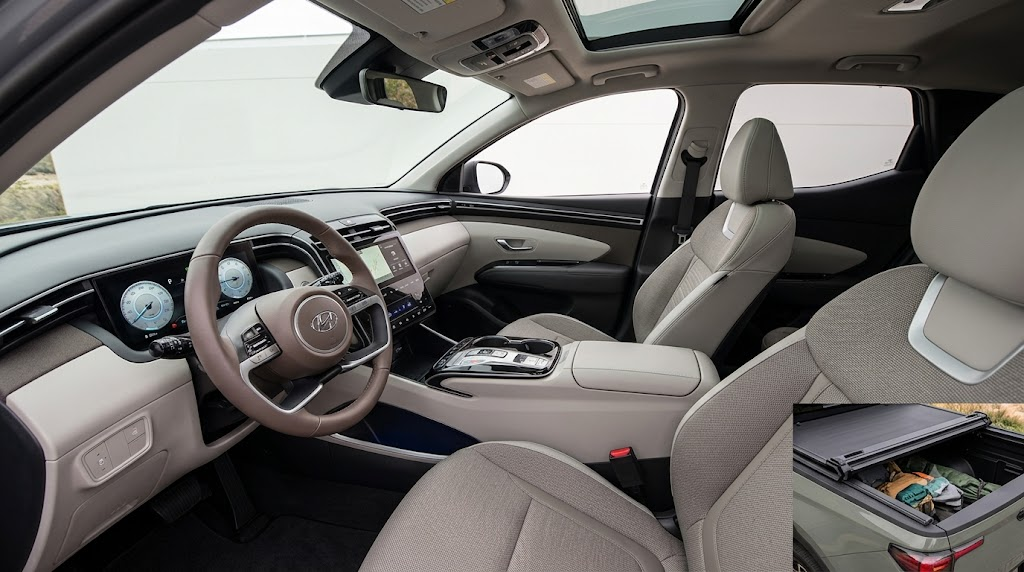
Inside, the Santa Cruz is much closer to a compact SUV than a conventional truck.
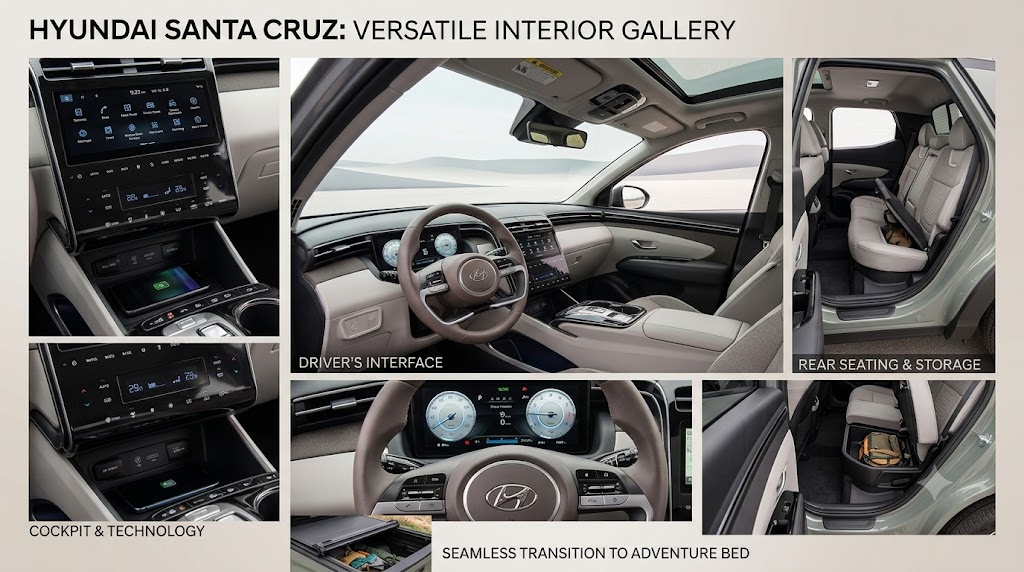
It seats five people and offers a modern dashboard, large touchscreen and a range of convenience features depending on trim.
Front legroom measures 41.4 inches, while rear legroom is approximately 36.5 inches.
The rear seat area also benefits from the Santa Cruz’s SUV-based design. Owners can use the cabin for passengers while reserving the exterior bed for dirty, wet or oversized objects.
This is one of the fundamental advantages of the Santa Cruz formula.
With a conventional SUV, carrying muddy equipment can mean putting it inside the vehicle. With the Santa Cruz, the same equipment can go into the bed.
Infotainment and Technology
The 2026 Santa Cruz offers a 12.3-inch touchscreen, with navigation available depending on trim.
Wireless Apple CarPlay and Android Auto are available, while higher trims add additional technology and premium equipment.
Available technology includes:
- 12.3-inch touchscreen
- Wireless Apple CarPlay
- Wireless Android Auto
- Wireless smartphone charging
- Digital instrument display
- Hyundai Digital Key
- Navigation
- Bose premium audio
- Surround View Monitor
- Blind-Spot View Monitor
- USB-C ports
Higher trims provide a more premium interior experience and additional driver-assistance technology.
Hyundai Santa Cruz Safety
Safety is another important part of the Santa Cruz package.
The 2026 model is equipped with eight airbags, electronic stability control, traction control, brake assist, Vehicle Stability Management and tire-pressure monitoring as standard equipment.
The Santa Cruz also includes Hyundai’s SmartSense driver-assistance technologies.
Depending on configuration, these include:
- Forward Collision-Avoidance Assist
- Pedestrian and cyclist detection
- Lane Keeping Assist
- Lane Following Assist
- Blind-Spot Collision Warning
- Rear Cross-Traffic Collision-Avoidance Assist
- Safe Exit Warning
- Smart Cruise Control
- Highway Driving Assist
- Blind-Spot View Monitor
- Surround View Monitor
2026 Hyundai Santa Cruz IIHS Safety Rating
The Insurance Institute for Highway Safety currently lists the 2026 Hyundai Santa Cruz as a Top Safety Pick.
Its current IIHS evaluation includes a Good rating for the small-overlap front test and an Acceptable rating in the updated moderate-overlap front test. Its updated side evaluation is rated Good.
The IIHS also reports a Good headlight rating and evaluates the standard pedestrian front-crash prevention system as Acceptable.
| IIHS area | 2026 Santa Cruz |
|---|---|
| Small overlap front | Good |
| Updated moderate overlap front | Acceptable |
| Updated side | Good |
| Headlights | Good |
| Pedestrian front crash prevention | Acceptable |
| Overall award | Top Safety Pick |
Safety ratings can change as testing criteria are updated, so buyers should check the latest IIHS information for the exact model year and configuration.
2026 Hyundai Santa Cruz Trim Levels
Santa Cruz SE
The SE is the entry point into the lineup.
It gets the 191-horsepower 2.5-liter engine, an eight-speed automatic transmission, five-passenger seating and a 12.3-inch touchscreen.
Front-wheel drive is standard and HTRAC AWD is available.
For buyers who mainly want the Santa Cruz concept at the lowest starting price, the SE provides the basic formula without the additional cost of the higher trims.
Santa Cruz SEL
The SEL adds additional comfort and convenience equipment.
It remains powered by the 191-horsepower engine and offers the same basic FWD/AWD choice.
It is positioned above the SE for buyers who want additional features without moving into the turbocharged powertrain.
Santa Cruz SEL Activity
The SEL Activity is a more lifestyle-oriented version of the naturally aspirated Santa Cruz.
It adds features aimed at improving comfort and outdoor practicality while retaining the 191-horsepower engine.
This trim can make sense for someone who wants more equipment but does not necessarily need the turbocharged XRT.
Santa Cruz XRT
The XRT represents a major change in specification.
It gets:
- 281-horsepower turbocharged engine
- 311 lb-ft of torque
- Standard HTRAC AWD
- 8-speed automatic transmission
- XRT-specific exterior design
- 18-inch wheels
- Additional convenience and technology features
The XRT is designed for buyers who want more performance and an adventure-oriented appearance.
Santa Cruz Limited
The Limited is the premium version of the lineup.
It combines the turbocharged engine and AWD with additional comfort and technology.
Depending on configuration, features include:
- Leather-trimmed seating
- Heated front seats
- Ventilated front seats
- Heated steering wheel
- Bose premium audio
- Navigation
- Digital instrument display
- Blind-Spot View Monitor
- Surround View Monitor
The Limited is therefore less about basic utility and more about combining pickup practicality with a premium SUV-like experience.
2026 Hyundai Santa Cruz vs Ford Maverick
The Ford Maverick is probably the most direct competitor to the Santa Cruz.
Both are compact unibody pickups designed for buyers who want truck utility without the size of a traditional pickup.
| Feature | Hyundai Santa Cruz | Ford Maverick |
|---|---|---|
| Starting price in C&D comparison | $31,350 | $29,990 |
| Seating | 5 | 5 |
| Base powertrain | 191-hp gas | 191-hp hybrid |
| Turbo option | 281 hp | 250 hp |
| Maximum towing | 5,000 lbs | 4,000 lbs |
| Maximum EPA combined MPG | 25 mpg | Up to 37 mpg |
| Basic warranty | 5 yr/60,000 mi | 3 yr/36,000 mi |
The Maverick has an important fuel-economy advantage because of its available hybrid powertrain. The Santa Cruz, however, offers a stronger 281-horsepower turbocharged engine and a 5,000-pound maximum tow rating.
The two vehicles therefore appeal to slightly different priorities.
2026 Hyundai Santa Cruz vs Honda Ridgeline
The Honda Ridgeline is larger and belongs to the midsize pickup category, while the Santa Cruz is a compact pickup.
| Feature | Hyundai Santa Cruz | Honda Ridgeline |
|---|---|---|
| Segment | Compact pickup | Midsize pickup |
| Turbo power | 281 hp | 280 hp V6 |
| Torque | 311 lb-ft | 262 lb-ft |
| Maximum towing | 5,000 lbs | 5,000 lbs |
| Seating | 5 | 5 |
| Basic warranty | 5 yr/60,000 mi | 3 yr/36,000 mi |
| Starting price in C&D comparison | $31,350 | $42,390 |
The Ridgeline provides a larger cabin and a more substantial pickup package, while the Santa Cruz is smaller and positioned at a lower price point.
The Santa Cruz turbo also produces more torque than the Ridgeline’s V6 according to the listed specifications.
Hyundai Santa Cruz vs a Traditional Pickup
The biggest difference is construction and intended use.
Traditional pickups generally prioritize heavy-duty work, larger beds, payload capability and towing.
The Santa Cruz instead prioritizes:
- Passenger comfort
- Compact dimensions
- SUV-like driving
- Everyday usability
- Technology
- Light recreational utility
That distinction matters.
Someone who spends most of their time commuting and occasionally needs a cargo bed may find the Santa Cruz concept appealing.
Someone who regularly carries heavy construction materials or needs a long bed may be better served by a conventional pickup.
What Makes the Hyundai Santa Cruz Different?
The Santa Cruz does not try to be the biggest truck.
Its appeal comes from combining several characteristics that are normally separated.
You get a five-seat cabin.
You get SUV-like road manners.
You get an open cargo bed.
You can choose AWD.
You can tow up to 5,000 pounds with the turbocharged version.
And you can get a premium equipment package without moving into a large pickup.
That combination is the reason the Santa Cruz has carved out a distinct position in the market.
Pros and Cons of the 2026 Hyundai Santa Cruz
Pros
- SUV-like driving experience: The Santa Cruz is designed around everyday road use rather than heavy-duty truck work.
- Strong turbo engine: The 281-horsepower turbocharged engine provides quick acceleration and 311 lb-ft of torque.
- 5,000-pound towing capacity: Turbocharged models provide substantial towing capability for a compact pickup.
- Useful cargo bed: The 52.1-inch bed provides a separate space for bulky or dirty equipment.
- Modern technology: The 12.3-inch touchscreen and available premium technology give the cabin a modern feel.
- Available AWD: HTRAC AWD is available on lower trims and standard on XRT and Limited.
Strong warranty: Hyundai provides a 5-year/60,000-mile new-vehicle limited warranty and a 10-year/100,000-mile powertrain limited warranty in the U.S., subject to the applicable terms and limitations.
Cons
- Short cargo bed: The bed is considerably shorter than that of many traditional pickups.
- Turbo fuel economy: The XRT and Limited are rated at only 20 mpg combined.
- Higher turbo pricing: Moving from the SEL Activity to the XRT is a substantial price jump.
- Not a heavy-duty truck: The Santa Cruz is intended for lifestyle and light-duty utility rather than demanding commercial work.
- Limited market availability: The Santa Cruz is primarily sold in selected markets and is not part of Hyundai’s regular Indian-market lineup.
Is the Hyundai Santa Cruz a Good Daily Driver?
The Santa Cruz’s design makes it particularly suited to daily use.
It has five seats, a relatively compact footprint, modern infotainment and SUV-like road manners.
The cargo bed provides an advantage for owners who regularly transport things that would be inconvenient to carry inside an SUV.
The turbocharged version also gives the vehicle enough performance to feel comfortable on highways.
For someone who wants a vehicle that can commute during the week and carry outdoor equipment on weekends, the Santa Cruz’s combination of features is particularly relevant.
Is the Hyundai Santa Cruz Good for Long Drives?
The Santa Cruz is designed primarily for road use, and its suspension and cabin are oriented toward everyday comfort.
The turbocharged engine can make highway driving easier, particularly when overtaking or when the vehicle is carrying several passengers.
Its available driver-assistance features can also reduce fatigue on longer journeys, although these systems remain assistance technologies and do not replace an attentive driver.
Is the Hyundai Santa Cruz Good for Off-Road Driving?
The Santa Cruz can handle light recreational off-road use, particularly in an AWD configuration.
However, it should not be confused with a body-on-frame off-road pickup designed for extreme terrain.
Its strongest use case is a combination of paved roads, gravel roads, camping areas and moderate outdoor adventures rather than serious rock crawling.
The XRT’s standard AWD and adventure-oriented design make it the most obvious choice for buyers interested in this type of use.
Is the Hyundai Santa Cruz Worth Considering?
The answer depends heavily on what a buyer expects from a pickup.
The Santa Cruz is not intended to replace a full-size work truck.
Its purpose is different.
It is designed for people who want the comfort and everyday usability of an SUV but also want the ability to throw bicycles, tools, camping equipment, gardening supplies or other bulky items into an open bed.
The 2026 model expands that concept with a choice of two engines, available or standard AWD depending on trim, modern technology, strong safety equipment and up to 5,000 pounds of towing capacity.
The Ford Maverick remains an important alternative, particularly for buyers prioritizing hybrid fuel economy. The Honda Ridgeline is another option for buyers who need a larger midsize pickup.
Ultimately, the Santa Cruz occupies a very specific space between an SUV and a traditional pickup.
That is also its biggest selling point.
Frequently Asked Questions About the Hyundai Santa Cruz
What is the starting price of the 2026 Hyundai Santa Cruz?
The 2026 Hyundai Santa Cruz starts at $29,750 MSRP in the United States before freight, taxes, title, license and other applicable fees.
How much horsepower does the 2026 Hyundai Santa Cruz have?
The standard 2.5-liter engine produces 191 horsepower. The turbocharged 2.5-liter engine in the XRT and Limited produces 281 horsepower.
How much can the Hyundai Santa Cruz tow?
The standard engine is rated for up to 3,500 pounds, while turbocharged models can tow up to 5,000 pounds when properly equipped.
Does the Hyundai Santa Cruz have AWD?
Yes. HTRAC AWD is available on the SE, SEL and SEL Activity and standard on the XRT and Limited.
How many people can the Santa Cruz seat?
The Hyundai Santa Cruz seats five people.
How big is the Santa Cruz truck bed?
The bed is 52.1 inches long, 19.2 inches deep and up to 53.9 inches wide. Hyundai lists 27 cubic feet of bed volume.
What is the Hyundai Santa Cruz MPG?
The most efficient FWD models are rated at 22 mpg city, 30 mpg highway and 25 mpg combined. AWD versions of the naturally aspirated models are rated at 21/29/24 mpg, while the turbocharged XRT and Limited are rated at 18/25/20 mpg.
Is the Santa Cruz bigger than the Ford Maverick?
Both are compact pickups, but their dimensions and bed designs differ. The Santa Cruz measures 195.7 inches long, while the Maverick is also designed around a compact footprint. The two vehicles are direct competitors in the compact pickup segment.
Is the Hyundai Santa Cruz safe?
The 2026 Santa Cruz is listed by IIHS as a Top Safety Pick. Its current evaluation includes Good ratings in the small-overlap front and updated side tests, while the updated moderate-overlap front test is rated Acceptable.
Does the 2026 Santa Cruz have a hybrid engine?
No. The 2026 Santa Cruz uses gasoline-powered four-cylinder engines. The Ford Maverick offers a hybrid powertrain, making it an important alternative for buyers focused on fuel economy.
Is the Hyundai Santa Cruz available in India?
The Santa Cruz is primarily sold in markets such as the United States and is not part of Hyundai India’s regular locally sold lineup. Importing one into India would involve different taxation, registration, homologation and after-sales considerations.
Final Verdict: What Kind of Vehicle Is the Santa Cruz?
The Hyundai Santa Cruz is best understood as a compact lifestyle pickup with SUV characteristics.
It is smaller and easier to live with than many traditional pickups, while its open bed provides functionality that a normal SUV cannot match.
For 2026, the formula becomes particularly interesting because buyers can choose between an economical 191-horsepower engine and a substantially more powerful 281-horsepower turbocharged engine.
The turbocharged version also delivers 5,000 pounds of towing capacity, while the available HTRAC AWD system expands its capability in poor weather and on light off-road surfaces.
At the same time, the short bed means the Santa Cruz is not a replacement for a full-size or heavy-duty pickup.
Its real strength is versatility.
It can serve as a commuter, family vehicle, weekend adventure vehicle and occasional work vehicle without becoming as large or truck-like as a conventional pickup.
For buyers who want those characteristics in one vehicle, the 2026 Hyundai Santa Cruz offers a distinctive approach to the compact pickup segment.