The Ford Ranger pickup truck sits in the middle of Ford’s truck lineup, offering more capability than the compact Maverick while remaining smaller and easier to manage than the full-size F-150.
The current U.S. Ranger is part of the latest generation introduced for 2024, and the 2026 model continues with a strong combination of turbocharged engines, available four-wheel drive, useful payload capacity and a maximum towing rating of 7,500 pounds.
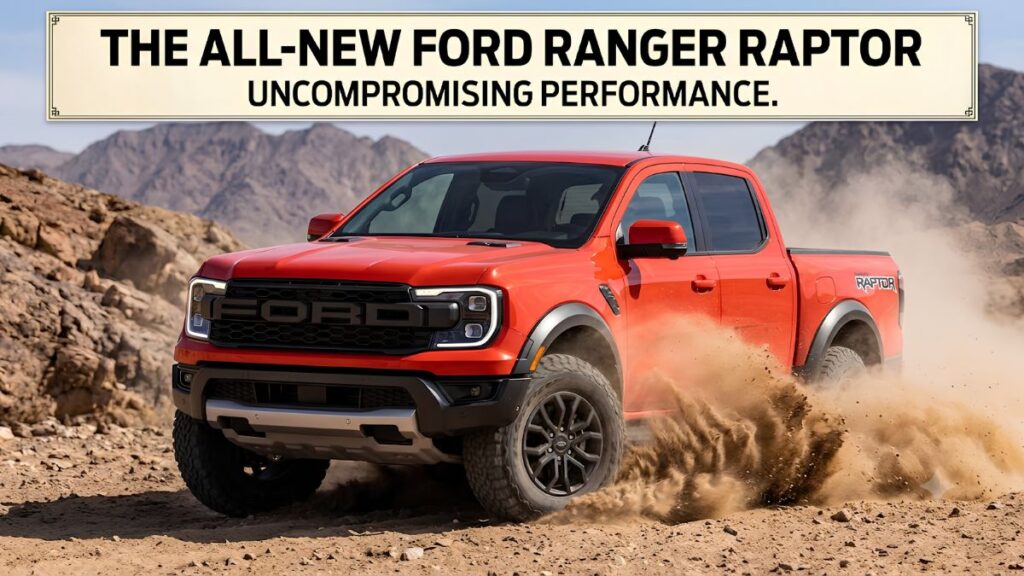
The Ranger lineup also includes the Ranger Raptor, which takes the midsize pickup in a very different direction with a 3.0-liter EcoBoost V6, 430 lb-ft of torque, FOX Live Valve dampers, locking front and rear axles and standard four-wheel drive.
For buyers who need a practical midsize truck for work, towing, daily driving or weekend adventures, the Ranger remains one of the most versatile choices in its class.
2026 Ford Ranger Price
The 2026 Ford Ranger starts at $33,550 MSRP in Ford’s current U.S. lineup. Ford notes that its base MSRP excludes destination and delivery charges, taxes, government fees, dealer fees and optional equipment.
The Ranger is available in four primary U.S. versions:
- XL
- XLT
- Lariat
- Raptor
The exact price depends on trim, engine, drivetrain, packages and options.
The Raptor is positioned separately as the performance-focused version. Ford currently lists the 2026 Ranger Raptor starting at $57,270 MSRP.
| 2026 Ford Ranger | Starting MSRP |
|---|---|
| Ranger XL | From $33,550 |
| Ranger XLT | Higher than XL |
| Ranger Lariat | Higher than XLT |
| Ranger Raptor | $57,270 |
Ford’s online inventory can show different net MSRPs depending on equipment and dealer configuration, so buyers should use the base MSRP only as a starting point.
Is the Ford Ranger a Midsize Truck?
Yes.
The Ford Ranger is a midsize pickup truck.
It competes against vehicles such as the Toyota Tacoma, Chevrolet Colorado, GMC Canyon and Nissan Frontier.
The Ranger is smaller than the Ford F-150, but it still provides a useful 5-foot bed, available 4×4 and a maximum towing capacity of 7,500 pounds.
That makes it a good middle ground for buyers who want truck capability without moving to a full-size pickup.
Ford Ranger Engine Options
The 2026 Ranger offers three EcoBoost engines in the U.S.
| Engine | Horsepower | Torque | Availability |
|---|---|---|---|
| 2.3L EcoBoost I4 | 270 hp | 310 lb-ft | Standard |
| 2.7L EcoBoost V6 | 315 hp | 400 lb-ft | Available |
| 3.0L EcoBoost V6 | 405 hp | 430 lb-ft | Raptor |
All three engines use a 10-speed automatic transmission. The 2.3-liter is standard on XL, XLT and Lariat, while the 2.7-liter V6 is available on XLT and Lariat. The 3.0-liter V6 is exclusive to the Ranger Raptor.
2.3L EcoBoost
The 2.3-liter EcoBoost four-cylinder is the standard Ranger engine.
It produces:
- 270 horsepower
- 310 lb-ft of torque
It is available with either 4×2 or 4×4 depending on configuration.
This engine is the logical choice for buyers who want to keep the purchase price and operating costs lower while still having enough torque for regular truck duties.
It can also deliver the Ranger’s maximum 7,500-pound towing rating when properly configured.
2.7L EcoBoost V6
The available 2.7-liter EcoBoost V6 is aimed at buyers who want more performance.
It produces:
- 315 horsepower
- 400 lb-ft of torque
Ford makes it available on the XLT and Lariat, and it requires four-wheel drive.
The additional torque makes the 2.7-liter particularly attractive for buyers who frequently tow, carry equipment or want stronger acceleration.
Ford’s official towing guide lists the 2.7-liter EcoBoost with a maximum loaded trailer weight of 7,500 pounds in the appropriate SuperCrew 4×4 configuration.
3.0L EcoBoost V6
The 3.0-liter EcoBoost V6 is exclusive to the Ranger Raptor.
It produces 405 horsepower and 430 lb-ft of torque.
That makes the Raptor significantly more powerful than the regular Ranger.
However, maximum horsepower does not mean maximum towing. The Raptor’s maximum available towing capacity is 5,510 pounds, because its chassis, suspension, tires and off-road hardware are optimized for high-speed off-road driving rather than maximum trailer capacity.
Ford Ranger Towing Capacity
The 2026 Ford Ranger can tow up to 7,500 pounds when properly equipped.
This rating applies to specific engine and drivetrain configurations.
Ford’s official towing guide lists the 2.3-liter EcoBoost at up to 7,500 pounds in the appropriate 4×2 and SuperCrew 4×4 configurations. The 2.7-liter EcoBoost V6 can also reach 7,500 pounds in the appropriate SuperCrew 4×4 configuration.
The Raptor is different.
Its maximum trailer rating is 5,510 pounds.
This distinction is important when comparing Ranger trims.
| Ranger version | Max towing |
|---|---|
| 2.3L EcoBoost | Up to 7,500 lb |
| 2.7L EcoBoost V6 | Up to 7,500 lb |
| 3.0L EcoBoost Raptor | 5,510 lb |
The exact towing rating depends on vehicle configuration, cargo, passengers, accessories and required towing equipment.
Ford also specifies that trailers over 3,500 pounds require the Trailer Tow Package in the relevant configurations.
Ford Ranger Payload Capacity
The regular 2026 Ranger can carry up to 1,788 pounds of payload when properly configured.
Ford lists the maximum available payload by engine and drivetrain as follows:
| Engine | Drivetrain | Max available payload |
|---|---|---|
| 2.3L EcoBoost | 4×2 | 1,767 lb |
| 2.3L EcoBoost | 4×4 | 1,763 lb |
| 2.7L EcoBoost | 4×4 | 1,513 lb |
| 3.0L EcoBoost Raptor | 4×4 | 1,373 lb |
Ford’s published figures show why engine and drivetrain selection matters. The larger engines and heavier off-road equipment reduce maximum payload compared with the lighter 2.3-liter configuration.
For buyers who regularly carry heavy tools, building materials or equipment in the bed, the 2.3-liter Ranger can therefore be more useful than the Raptor.
Ford Ranger MPG
The most efficient 2026 Ranger configuration uses the 2.3-liter EcoBoost with 4×2.
Ford’s published fuel-economy information lists approximately:
| Powertrain | City | Highway |
|---|---|---|
| 2.3L EcoBoost 4×2 | 21 mpg | 25 mpg |
| 2.3L EcoBoost 4×4 | 19 mpg | 24 mpg |
| 2.7L EcoBoost 4×4 | 18 mpg | 23 mpg |
| 3.0L EcoBoost Raptor 4×4 | 16 mpg | 18 mpg |
Actual mileage varies with driving conditions, vehicle configuration, payload, tires and driving style.
The 2.3-liter engine is therefore the best choice for buyers who want the Ranger’s lowest fuel consumption.
The 2.7-liter V6 sacrifices some efficiency in exchange for considerably more torque.
The Raptor is the least efficient because it is built around performance and off-road capability.
Ford Ranger Trim Levels
Ford Ranger XL
The XL is the entry-level Ranger.
It comes with the 2.3-liter EcoBoost engine and 10-speed automatic transmission.
Standard equipment includes features such as:
- 17-inch black steel wheels
- All-terrain tires
- LED reflector headlamps
- Automatic high beams
- SYNC 4A
- 10-inch center display
- 8-inch instrument display
- Lane-Keeping System
- Second-row under-seat storage
The XL is the most straightforward choice for work and fleet buyers who care more about capability than luxury equipment.
Ford Ranger XLT
The XLT adds more comfort and technology.
It can be equipped with the 2.7-liter EcoBoost V6, which produces 315 horsepower and 400 lb-ft of torque.
Available features include:
- 12-inch center display
- 12-inch digital instrument display
- 360-degree camera
- Heated front seats
- ActiveX-trimmed seating
- Ford Co-Pilot360
- Sport Appearance Package
- FX4 Off-Road Package
- Advanced Towing Package
The XLT is likely to be one of the most balanced Ranger trims for private buyers.
Ford Ranger Lariat
The Lariat moves the Ranger toward a more premium experience.
It includes the 2.3-liter EcoBoost as standard and offers the 2.7-liter V6.
Standard equipment includes:
- 12-inch center display
- 12-inch instrument display
- ActiveX-trimmed seats
- 10-way power driver’s seat
- Heated front seats
- B&O sound system
- Sport Appearance Package
- Ford Co-Pilot360
- Technology Package
The Lariat is a good choice for buyers who use the Ranger as both a work truck and daily driver.
Ford Ranger Raptor
The Ranger Raptor is completely different from the regular Ranger.
It uses the 3.0-liter EcoBoost V6 and comes standard with 4×4.
Its hardware includes:
- 405-hp V6
- 430 lb-ft of torque
- 2.5-inch FOX Live Valve shocks
- Watts-link rear suspension
- Electronic-locking front and rear axles
- Seven selectable drive modes
- Baja mode
- Trail Control
- 33-inch all-terrain tires
- 17-inch wheels
- 400-watt Pro Power Onboard
Ford describes it as the pinnacle of Ranger performance.
Ford Ranger Raptor Review
The Ranger Raptor is not simply a more powerful Ranger.
Ford redesigned its suspension and chassis hardware around high-speed off-road driving.
The 2.5-inch FOX Racing shocks with Live Valve technology can continuously adjust damping according to terrain. The Watts-link rear suspension is also designed to provide better wheel control during aggressive off-road driving.
The Raptor has electronically locking front and rear axles, giving it a significant advantage when traction becomes limited.
Seven selectable drive modes allow the driver to change the truck’s behavior depending on the terrain.
Baja mode is particularly important because the Raptor is designed to handle high-speed desert-style driving rather than simply crawling over rocks.
The compromise is towing and payload.
With a 5,510-pound towing rating and lower payload than the regular Ranger, the Raptor is not the best Ranger for heavy work.
It is the best Ranger for buyers who want extreme off-road capability.
Ford Ranger FX4 Off-Road Package
The FX4 package gives the regular Ranger more off-road ability without the cost and extreme hardware of the Raptor.
It is available on 4×4 versions and adds off-road-focused equipment.
This makes the FX4 a sensible choice for buyers who spend time on dirt roads, trails, campsites and rough terrain but still need a practical truck for everyday use.
The difference between FX4 and Raptor is significant.
FX4 is an off-road package.
Raptor is a purpose-built performance truck.
Ford Ranger Ground Clearance
The standard Ranger has a minimum running ground clearance of 9.3 inches.
The Ranger Raptor increases that figure to 10.7 inches.
That extra clearance is useful when driving over rocks, deep ruts and uneven trails.
The Raptor also combines its greater clearance with specialized suspension travel and larger tires, so its off-road advantage is not simply a matter of height.
Ford Ranger Bed Size
The 2026 Ranger uses a 5-foot bed.
Ford lists the bed dimensions as:
- Length: 59.6 inches
- Width: 62.4 inches
- Depth: 20.6 inches
- Width between wheel wells: 48.2 inches
- Cargo volume: 43.5 cubic feet
The Raptor has the same basic bed length and cargo volume, although its bed depth is listed at 20.8 inches.
The 43.5-cubic-foot bed provides useful space for tools, camping equipment, sports gear and everyday cargo.
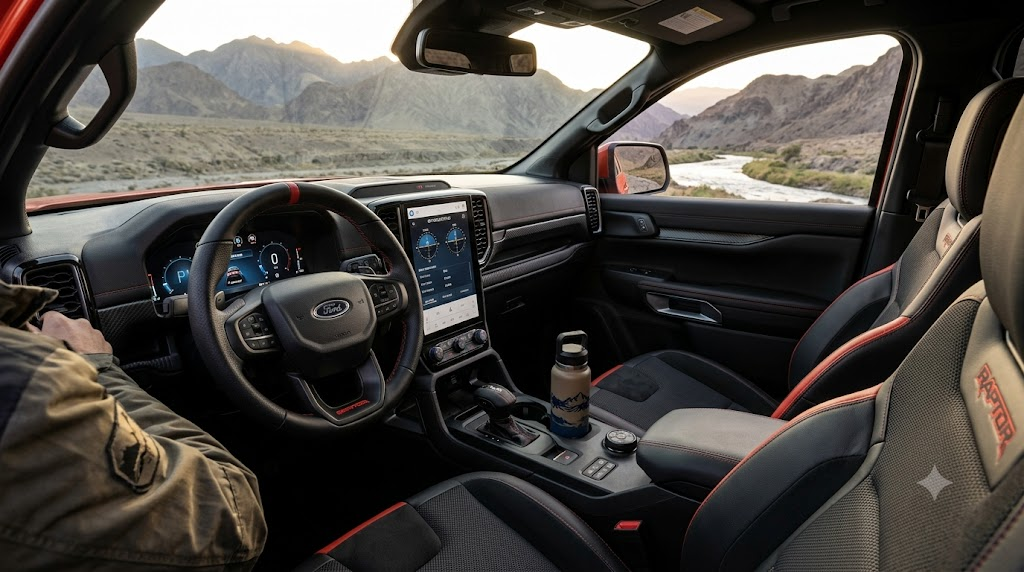
Ford Ranger Interior
The Ranger’s interior is more modern than the previous-generation truck.
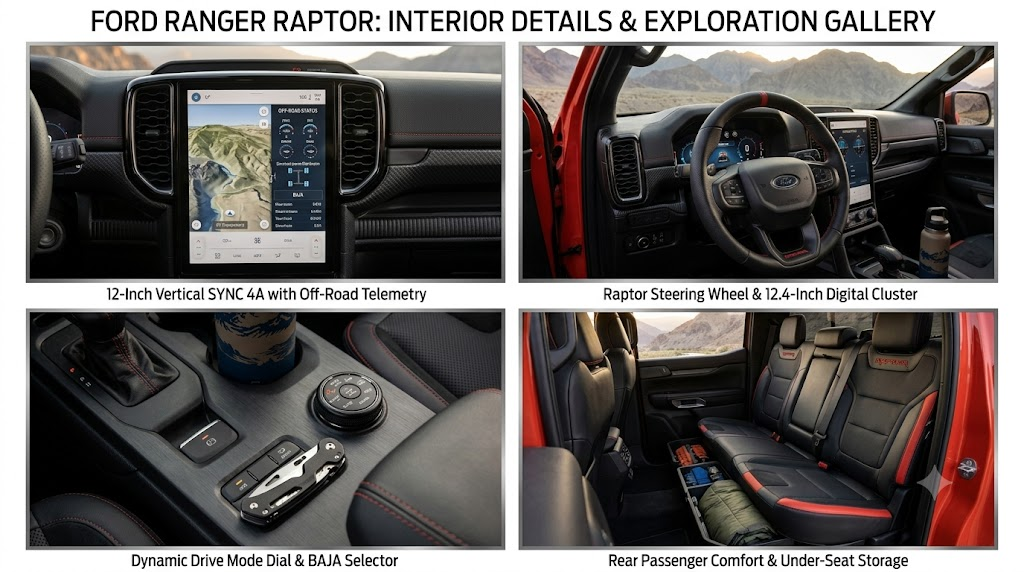
The standard XL gets a 10-inch center display and 8-inch instrument cluster, while XLT and Lariat versions can use 12-inch screens.
Available equipment includes:
- 12-inch digital instrument cluster
- 12-inch touchscreen
- SYNC 4A
- Wireless phone charging
- Heated seats
- ActiveX seating
- B&O audio
- Connected navigation
- 360-degree camera
- Ambient lighting
Ford has also built useful storage into the cabin.
The truck has under-seat rear storage, large door pockets and additional interior storage areas designed around tools and equipment.
Ford Ranger Technology
The Ranger is available with several technology features that make it easier to use as a daily vehicle.
The 360-degree camera can help when parking or maneuvering in tight areas.
Ford also offers available Pro Power Onboard with 400 watts, allowing owners to power compatible equipment from outlets in the truck. The feature is especially useful for camping, outdoor activities and work sites.
The Ranger also offers Ford Co-Pilot360 technology, depending on trim and package.
Ford Ranger Safety
The Ranger is available with Ford Co-Pilot360 technology and several driver-assistance features.
Depending on trim and equipment, buyers can get systems designed to assist with:
- Lane keeping
- Blind spot monitoring
- Rear cross-traffic alert
- Pre-collision warning
- Automatic emergency braking
- Adaptive cruise control
- Parking assistance
- 360-degree camera views
Equipment varies by trim and package, so buyers should check the exact configuration.
Ford Ranger 4×4
Four-wheel drive is available across the Ranger lineup and standard on the Raptor.
The XL, XLT and Lariat use an electronic shift-on-the-fly 4×4 system when equipped with four-wheel drive.
The Raptor comes with standard 4×4 and a much more advanced off-road chassis.
For buyers who regularly encounter snow, mud, gravel or trails, 4×4 can be worth the additional cost.
For primarily paved-road use, 4×2 can reduce purchase price, weight and fuel consumption.
Ford Ranger vs Toyota Tacoma
The Toyota Tacoma is one of the Ranger’s closest competitors.
Both are midsize pickups with strong off-road versions and multiple powertrains.
The Ranger has several advantages, including:
- Available 2.7-liter EcoBoost V6
- 7,500-pound maximum towing
- Ranger Raptor
- 405-hp Raptor engine
- 430 lb-ft of Raptor torque
- 400-watt Pro Power Onboard
The Tacoma counters with its own strong off-road lineup, including TRD Pro and Trailhunter, as well as an available i-FORCE MAX hybrid powertrain.
The choice largely comes down to engine preference, off-road priorities, technology and dealer pricing.
Ford Ranger vs Chevrolet Colorado
The Chevrolet Colorado is another direct Ranger competitor.
Both offer turbocharged engines, 4×4 capability, off-road variants and towing capacity around the 7,500-pound range.
The Ranger’s major advantage is the availability of the Raptor, while the Colorado has its own ZR2 off-road flagship.
For buyers who want an extreme off-road midsize truck, the Ranger Raptor and Colorado ZR2 are particularly interesting alternatives.
For normal towing and daily driving, the standard Ranger and Colorado are more relevant comparisons.
Ford Ranger vs Nissan Frontier
The Nissan Frontier uses a naturally aspirated 3.8-liter V6, while the Ranger uses turbocharged EcoBoost engines.
The Frontier produces 310 horsepower and 281 lb-ft of torque in the current model, while the Ranger’s 2.3-liter EcoBoost produces 270 horsepower and 310 lb-ft.
The Ranger therefore emphasizes turbocharged torque, while the Frontier uses a traditional naturally aspirated V6.
The Ranger also offers the Raptor, giving it a much more specialized performance option.
Is the Ford Ranger a Good Truck?
Yes, the Ranger is one of the more versatile midsize pickups in the U.S. market.
Its strengths include:
- Strong turbocharged engines
- 7,500-pound towing capacity
- Up to 1,788-pound payload
- Available 4×4
- 43.5-cubic-foot bed
- Useful interior storage
- Modern technology
- Available 2.7-liter V6
- High-performance Raptor
- Good off-road options
- 400-watt Pro Power Onboard
The main limitation is that the Ranger does not offer the same overall size and maximum towing capacity as a full-size F-150.
That is not necessarily a disadvantage.
For buyers who do not need a large truck, the Ranger can be easier to maneuver and park while still providing substantial towing and hauling capability.
Which Ford Ranger Engine Is Best?
The answer depends on how the truck will be used.
Best value: 2.3L EcoBoost
Best for towing: 2.3L or 2.7L EcoBoost with the proper configuration
Best for performance: 2.7L EcoBoost
Best for extreme off-roading: 3.0L EcoBoost V6 in the Raptor
Best for fuel economy: 2.3L EcoBoost 4×2
For most private buyers, the 2.3-liter EcoBoost provides the best balance of price, power, towing and fuel economy.
The 2.7-liter EcoBoost V6 is more attractive if stronger acceleration and torque are priorities.
The Raptor should be selected because of its off-road performance, not because it is the most practical Ranger for towing.
2027 Ford Ranger: What We Know
As of October 2026, Ford’s U.S. consumer lineup continues to list the 2026 Ranger rather than providing a complete U.S. 2027 Ranger specification. Ford’s current U.S. truck lineup lists the 2026 Ranger starting at $33,550.
There is, however, a confirmed 2027 Ranger development for South America.
Ford has announced that production of a Ranger Plug-in Hybrid will begin in Argentina in 2027. Ford describes it as the first electrified Ranger produced in the region.
That announcement does not establish U.S. availability, U.S. pricing or U.S. specifications.
Therefore, buyers searching for a “2027 Ford Ranger” should be careful with websites that publish specific U.S. horsepower, MPG or pricing figures without an official Ford source.
Ford Ranger Reliability
The current-generation Ranger has been on the market since the 2024 model year, but long-term reliability should still be evaluated separately from older Ranger generations.
The EcoBoost engines are widely used across Ford’s lineup, but individual engine history should not automatically be treated as proof of long-term reliability for every current Ranger configuration.
The Raptor is also mechanically more complex than a standard Ranger because of its specialized suspension and off-road hardware.
For buyers keeping a truck for many years, the standard 2.3-liter Ranger may be easier to justify from a simplicity and cost perspective than the highly specialized Raptor.
Final Ford Ranger Review
The Ford Ranger occupies an attractive position in the pickup market.
It is considerably more capable than a small truck such as the Maverick while avoiding the size and cost of a full-size F-150.
The standard 2.3-liter EcoBoost produces 270 horsepower and 310 lb-ft of torque, while the optional 2.7-liter V6 raises output to 315 horsepower and 400 lb-ft.
Both can reach a 7,500-pound maximum towing rating in the appropriate configuration.
Then there is the Ranger Raptor.
With 405 horsepower, 430 lb-ft of torque, FOX Live Valve dampers, locking front and rear axles, 4×4 and Baja mode, it is one of the most serious off-road pickups in the midsize segment.
The compromise is that the Raptor sacrifices towing and payload capacity for its specialized off-road hardware.
For most buyers, the regular Ranger is the more sensible choice.
The XLT with the 2.3-liter or 2.7-liter engine is particularly attractive for buyers who want a balance of comfort, capability and price.
The Lariat is better suited to buyers who want a more premium daily-driving experience.
The Raptor is for enthusiasts who want an off-road performance truck first and a practical pickup second.
Overall, the Ford Ranger remains a strong midsize pickup because it offers enough variety to serve very different buyers. It can be a work truck, commuter, towing vehicle, weekend adventure truck or high-performance off-road machine depending on the configuration.
Ford Ranger FAQs
What is the price of the Ford Ranger?
The 2026 Ford Ranger starts at $33,550 MSRP before destination, taxes, fees, options and dealer charges.
How much horsepower does the Ford Ranger have?
The 2.3-liter EcoBoost produces 270 horsepower, the 2.7-liter EcoBoost V6 produces 315 horsepower and the Ranger Raptor’s 3.0-liter EcoBoost V6 produces 405 horsepower.
How much torque does the Ford Ranger have?
The 2.3-liter EcoBoost produces 310 lb-ft, the 2.7-liter V6 produces 400 lb-ft and the Raptor produces 430 lb-ft.
How much can the Ford Ranger tow?
The 2026 Ranger can tow up to 7,500 pounds when properly equipped. The Ranger Raptor is rated at 5,510 pounds.
What is the Ford Ranger payload capacity?
The 2026 Ranger has a maximum available payload capacity of 1,788 pounds in the appropriate configuration.
Does the Ford Ranger have a V6?
Yes. The Ranger offers an available 2.7-liter EcoBoost V6 with 315 horsepower and 400 lb-ft of torque. The Raptor uses a 3.0-liter EcoBoost V6.
Is the Ford Ranger turbocharged?
Yes. All current U.S. Ranger engines use turbocharging.
Does the Ford Ranger have 4×4?
Yes. Four-wheel drive is available on the XL, XLT and Lariat and standard on the Ranger Raptor.
What is the Ford Ranger Raptor?
The Ranger Raptor is the high-performance off-road version of the Ranger. It has a 405-hp 3.0-liter EcoBoost V6, FOX Live Valve dampers, locking front and rear axles and standard 4×4.
What is the Ford Ranger MPG?
The most efficient configuration is the 2.3-liter EcoBoost 4×2, rated at approximately 21 mpg city and 25 mpg highway.
What is the Ford Ranger bed size?
The Ranger’s bed is 59.6 inches long, 62.4 inches wide and 20.6 inches deep, with 43.5 cubic feet of cargo volume.
Is the Ford Ranger good for towing?
Yes. A properly equipped regular Ranger can tow up to 7,500 pounds, making it one of the more capable midsize pickups for towing.
Is the Ford Ranger good for off-roading?
Yes. The standard Ranger can be equipped with the FX4 Off-Road Package, while the Raptor is specifically engineered for high-performance off-road driving.
Is the Ford Ranger Raptor good for towing?
It can tow up to 5,510 pounds, but it is not the best Ranger for maximum towing. Its suspension, tires and chassis are designed primarily for high-speed off-road performance.
Is the Ford Ranger better than the Toyota Tacoma?
Both are strong midsize pickups. The Ranger offers the Raptor, turbocharged EcoBoost engines and up to 7,500 pounds of towing, while the Tacoma offers its own hybrid and off-road-focused versions.
Is the Ford Ranger better than the Chevy Colorado?
Both are competitive midsize pickups. The Ranger stands out with its Raptor, while the Colorado offers the ZR2. The best choice depends on towing, off-road use, engine preference and pricing.
Is the Ford Ranger reliable?
It is too early to make a definitive long-term reliability judgment for the current generation based on many years of ownership data. Buyers should evaluate the specific engine, configuration, warranty and maintenance requirements.
Is the Ford Ranger a full-size truck?
No. The Ford Ranger is a midsize pickup. The F-150 is Ford’s full-size pickup.
When did the current Ford Ranger generation start?
The current U.S. Ranger generation arrived for the 2024 model year.
Is there a 2027 Ford Ranger?
Ford has confirmed a Ranger Plug-in Hybrid for production in Argentina beginning in 2027, but that announcement does not confirm U.S. 2027 availability or specifications.
Which Ford Ranger engine is best?
For most buyers, the 2.3-liter EcoBoost provides the best balance of power, fuel economy and price. The 2.7-liter V6 is better for buyers who want more torque, while the 3.0-liter V6 Raptor is best for extreme off-road performance.