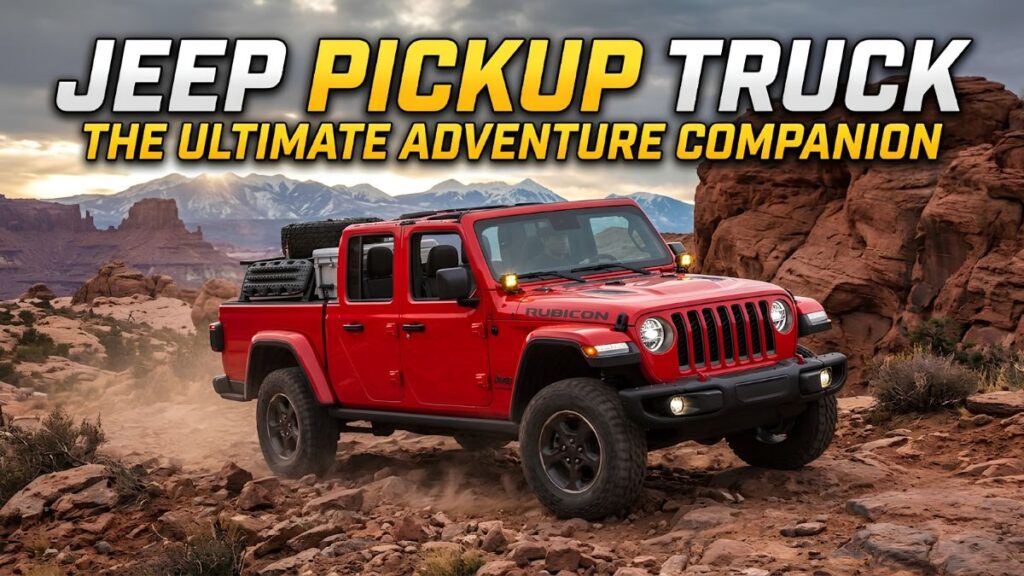
The Jeep pickup truck is the Jeep Gladiator, a midsize pickup designed around the same off-road philosophy that made the Wrangler famous. Unlike most midsize trucks, the Gladiator combines a traditional pickup bed with removable doors, a removable roof and serious four-wheel-drive hardware.
For 2026, the Jeep Gladiator starts at $39,820 MSRP in the U.S. The lineup includes Sport, Sport S, Willys, Sahara, Rubicon, Mojave and several special-edition models. Higher trims such as the Rubicon X and Mojave X push the price beyond $60,000.
The Gladiator uses a 3.6-liter Pentastar V6 producing 285 horsepower and 260 lb-ft of torque. An eight-speed automatic transmission is standard, and four-wheel drive is part of the Gladiator formula.
One of its biggest advantages is towing. Properly equipped, the Gladiator can tow up to 7,700 pounds, while maximum payload reaches 1,720 pounds in the appropriate configuration.
For 2027, Jeep has added the Gladiator Sarge, a limited-edition model inspired by the original 1941 military Jeep. It brings special colors, graphics, wheels, interior details and bronze tow hooks while retaining the Gladiator’s existing mechanical capability.
Jeep Pickup Price
The 2026 Jeep Gladiator starts at $39,820 MSRP before destination charges, taxes, registration, options and dealer-related costs. Jeep’s official specification page lists a $1,995 destination fee for the Sport shown in its detailed configuration.
The current 2026 lineup includes:
| Jeep Gladiator trim | Starting MSRP |
|---|---|
| Sport | $39,820 |
| Sport S | $43,015 |
| Willys | $45,750 |
| 85th Anniversary Edition | $46,810 |
| Sahara | $48,115 |
| Willys 41 | $48,360 |
| Rewind | $49,245 |
| Rubicon | $52,520 |
| Mojave | $53,215 |
| Shadow Ops | $57,515 |
| Rubicon X | $60,515 |
| Mojave X | $61,210 |
Pricing can change with configuration, options and model availability, so these figures should be treated as current advertised starting prices rather than final transaction prices.
The Sport is the logical starting point for buyers who want the Gladiator’s open-air design without paying for the more specialized off-road equipment.
The Rubicon and Mojave are more expensive because they are designed for substantially different types of off-road driving.
Jeep Gladiator Engine and Performance
The 2026 Jeep Gladiator uses one engine across the lineup: a 3.6-liter Pentastar V6.
It produces:
| Specification | Jeep Gladiator |
|---|---|
| Engine | 3.6L Pentastar V6 |
| Horsepower | 285 hp |
| Torque | 260 lb-ft |
| Transmission | 8-speed automatic |
| Drivetrain | 4×4 |
| Fuel | Regular gasoline |
The engine produces its maximum 285 horsepower at 6,400 rpm and 260 lb-ft of torque at 4,400 rpm.
Unlike many newer midsize pickups, the Gladiator does not currently rely on a turbocharged four-cylinder as its standard U.S. engine.
That gives the Gladiator a relatively straightforward powertrain compared with some competitors, although its naturally aspirated V6 does not produce the low-rpm torque numbers available from several turbocharged rivals.
The eight-speed automatic transmission is the primary transmission for the current U.S. Gladiator.
Jeep Gladiator Towing Capacity
The Jeep Gladiator towing capacity reaches 7,700 pounds when properly equipped.
That is one of the truck’s strongest specifications and makes the Gladiator useful for towing recreational equipment, trailers and other loads. Jeep describes the 7,700-pound figure as the maximum gas towing capacity in its class.
However, the maximum rating is configuration-dependent.
A base 2026 Gladiator Sport specification listed by Jeep has a 4,500-pound towing rating, while the maximum 7,700-pound figure requires the appropriate equipment and tow package.
That distinction matters when shopping for a Gladiator specifically for towing. Buyers should check the exact vehicle’s towing configuration rather than assuming every Gladiator can tow 7,700 pounds.
Is the Jeep Gladiator good for towing?
Yes, especially when properly equipped.
Its 7,700-pound maximum towing rating is competitive within the midsize pickup segment. The Gladiator also has a traditional body-on-frame pickup design and four-wheel-drive hardware that can be useful when towing on unpaved or uneven surfaces.
However, if maximum towing is the only priority, a full-size pickup such as the Ford F-150, Chevrolet Silverado 1500 or GMC Sierra 1500 offers substantially higher limits.
The Gladiator’s appeal is that it combines useful towing capacity with extreme off-road capability and open-air driving.
Jeep Gladiator Payload Capacity
The Gladiator can carry up to 1,720 pounds of payload in the appropriate configuration.
Jeep specifically lists the maximum 4×4 payload at 1,720 pounds on Gladiator Sport S models.
Payload includes everything placed in or on the vehicle, not just cargo in the bed. That means passengers, accessories and cargo all count toward the vehicle’s payload rating.
For buyers using the Gladiator as a work truck, the actual payload rating of the chosen configuration is more important than the headline maximum.
Jeep Gladiator Bed Size
The Gladiator has a 5-foot steel pickup bed.
Jeep’s official FAQ lists the cargo bed at 60.3 inches long with the tailgate closed and 56.8 inches wide. The truck also has integrated tie-downs and an easy-lift tailgate.
The bed is useful for camping equipment, motorcycles, tools, outdoor gear and other recreational cargo.
However, the Gladiator’s bed is shorter than the longer-bed configurations available on some competitors.
This is one area where the Gladiator prioritizes off-road proportions and versatility over maximum cargo volume.
Jeep Gladiator 4×4
Four-wheel drive is central to the Gladiator’s identity.
The truck is designed for serious off-road use, with available systems and equipment aimed at different types of terrain.
Depending on trim, buyers can get features such as:
- Locking differentials
- Sway bar disconnect
- Rock rails
- Skid plates
- Off-road tires
- Low-range gearing
- Trail-oriented drive modes
- Heavy-duty axles
- FOX off-road suspension components
The Rubicon is especially focused on rock crawling, while the Mojave is tuned for high-speed desert driving.
Jeep Gladiator Rubicon
The Gladiator Rubicon is the model to consider if your priority is technical off-roading.
Rubicon models can be equipped with 33-inch all-terrain tires and serious trail hardware. Jeep also offers features such as sway bar disconnect and protective equipment for difficult terrain.
The Rubicon’s purpose is not simply to look rugged.
Its hardware is designed to help the truck maintain traction and articulation when driving over rocks, deep ruts and uneven terrain.
For slow-speed technical trails, the Rubicon is one of the most capable midsize pickups available.
Jeep Gladiator Mojave
The Gladiator Mojave takes a different approach.
Instead of focusing primarily on rock crawling, the Mojave is designed around desert and high-speed off-road driving.
The Mojave and Mojave X use specialized suspension hardware and large off-road tires. Jeep also gives these models its Desert Rated designation for their capabilities in sandy terrain.
This makes the Mojave particularly interesting for buyers who want a pickup that can handle rough desert trails and high-speed bumps rather than primarily crawling over rocks.
Rubicon vs Mojave
The basic difference is simple.
Rubicon: better suited to technical rock crawling and slow-speed trail work.
Mojave: better suited to fast desert and rough-surface driving.
Both are serious off-road trucks, but their suspension and hardware are optimized for different environments.
Jeep Gladiator Open-Air Design
One of the biggest reasons people buy a Gladiator instead of another midsize pickup is the open-air design.
The roof can be removed, the doors can be removed and the windshield can be folded.
Jeep describes the Gladiator as the only open-air pickup in its segment with removable roof and doors.
That makes it fundamentally different from trucks such as the Toyota Tacoma, Ford Ranger, Chevrolet Colorado and Nissan Frontier.
For normal commuting, this feature is not essential.
For weekend adventures, however, it is one of the Gladiator’s defining characteristics.
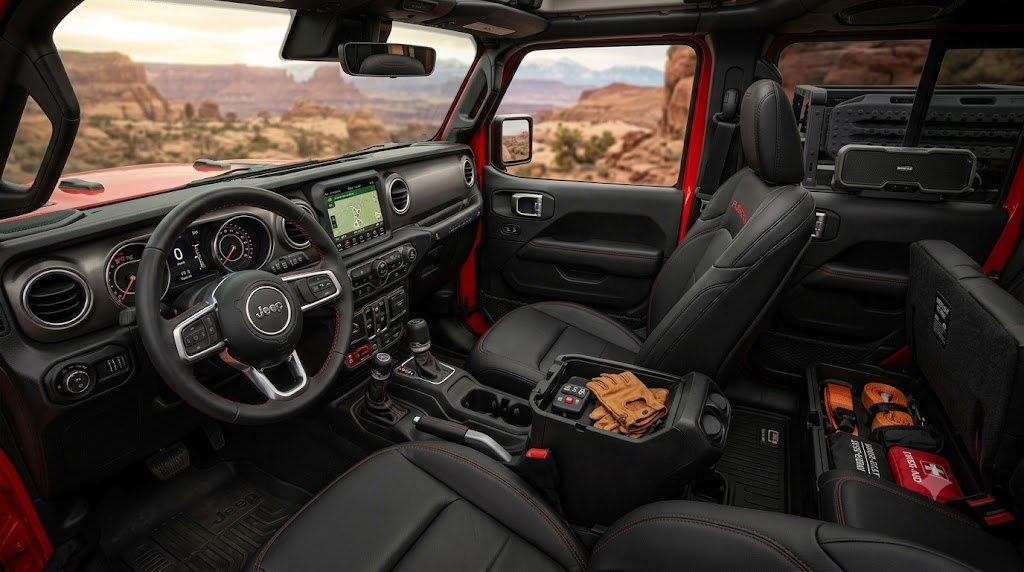
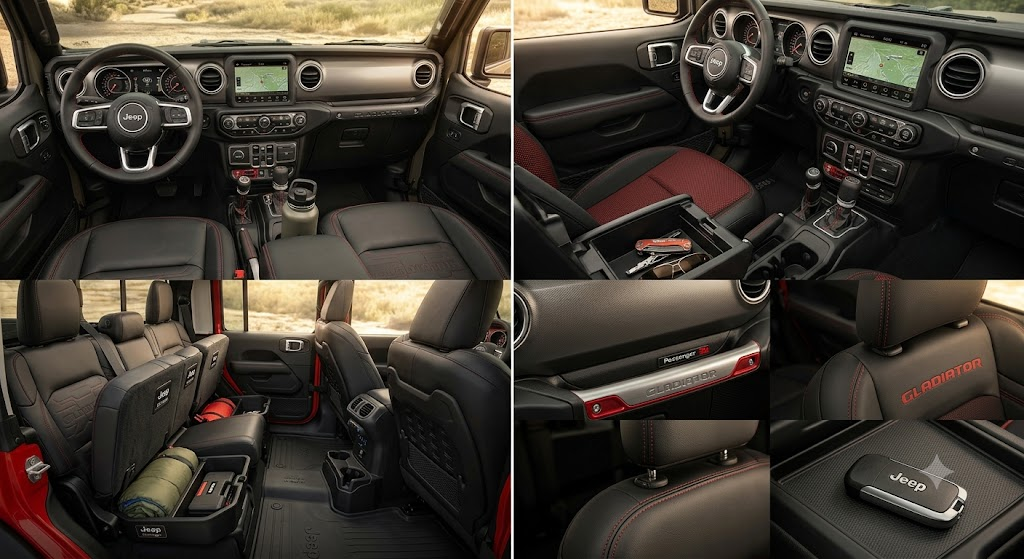
Jeep Gladiator Interior and Technology
The Gladiator is not just an old-fashioned off-road truck.
The current model offers a modern infotainment system with a standard 12.3-inch touchscreen, which Jeep describes as the largest standard touchscreen in its class.
Available technology includes:
- Uconnect 5 NAV
- Integrated off-road trail guides
- Apple CarPlay
- Android Auto
- Multiple USB and USB-C ports
- Available premium Alpine audio
- Jeep Connect services
- Digital driver information
- Available heated front seats
- Available 12-way power front seats
The integrated off-road trail guides are particularly useful because they bring trail information directly into the vehicle’s infotainment system.
Jeep Gladiator Off-Road Capability
Off-road ability is where the Gladiator separates itself from most conventional midsize pickups.
The truck combines a body-on-frame architecture with solid-axle hardware and Jeep’s established four-wheel-drive systems.
It can also be configured with equipment specifically designed for rock crawling, water crossings and desert driving.
Jeep says the front seats are designed for trail visibility and can withstand water fording up to 31.5 inches.
That does not mean every driving situation should involve water at that depth. Water crossings depend on conditions, speed, terrain, vehicle configuration and proper preparation.
The Gladiator’s Trail Rated credentials are also based on testing covering areas such as traction, water fording, maneuverability, articulation and ground clearance.
Jeep Gladiator Fuel Economy
Fuel economy is not the Gladiator’s strongest area.
A 2026 Gladiator Sport specification is rated at:
| Fuel economy | MPG |
|---|---|
| City | 17 |
| Highway | 22 |
| Combined | 19 |
The same specification uses regular gasoline and a 22-gallon fuel tank.
Actual fuel economy varies according to trim, tires, driving conditions, payload, speed and four-wheel-drive use.
Large off-road tires and aggressive suspension setups can also affect real-world fuel consumption.
If fuel economy is a major priority, buyers may find some turbocharged or hybrid competitors more appealing.
Jeep Gladiator Size
The Gladiator is a substantial midsize pickup.
Official Jeep specifications list:
| Dimension | Jeep Gladiator |
|---|---|
| Length | 218 inches |
| Width | 73.8 inches |
| Wheelbase | 137.3 inches |
| Bed length | 60.3 inches |
| Fuel tank | 22 gallons |
Its 137.3-inch wheelbase contributes to stability, but the truck is still large enough that narrow trails and tight parking areas can require attention.
The Gladiator’s proportions are also influenced by its Wrangler-based design philosophy.
2027 Jeep Gladiator
The biggest confirmed 2027 update is the Gladiator Sarge special edition.
Jeep introduced the Sarge as part of its Twelve 4 Twelve series, drawing inspiration from the original 1941 Willys MB military vehicle.
The Gladiator Sarge is based on the Willys and Rubicon versions and adds distinctive styling rather than introducing a completely new powertrain.
Its design includes:
- ’41 Green exterior elements
- Military-inspired star graphics
- 1941 hood decal
- ’41 Green painted wheels
- Bronze tow hooks
- Cattle Tan and Drab Green interior
- Heritage-inspired interior details
- Unique shift knob medallion
- Special rear swing-gate plaque
Jeep says the Gladiator Sarge will start at $500 above a comparably equipped Willys or Rubicon model.
The official Jeep website currently shows the 2027 Gladiator Sarge as a limited-quantity model, with production versions following the preproduction vehicle shown in Jeep’s promotional material.
Importantly, the Sarge is not a completely new generation of Gladiator. It is a special-edition version of the existing truck.
Does the 2027 Jeep Gladiator have a new engine?
There is no confirmed major new Gladiator powertrain announced with the 2027 Sarge update.
The Sarge is primarily a heritage-focused special edition. Jeep’s announcement emphasizes its appearance, interior details and existing off-road capability rather than introducing a new engine.
Therefore, buyers should be cautious about online claims suggesting a completely new 2027 Gladiator engine unless Jeep officially confirms them.
Jeep Gladiator vs Toyota Tacoma
The Toyota Tacoma is one of the Gladiator’s closest competitors.
The Tacoma offers a broader range of powertrains, including a turbocharged four-cylinder and i-FORCE MAX hybrid system, while the Gladiator continues with its naturally aspirated 3.6-liter V6 in the U.S.
The Gladiator has a major advantage in open-air capability because its doors and roof can be removed.
The Tacoma is generally a more conventional midsize pickup, with a wider focus on everyday driving, hauling and off-road use.
Choose the Gladiator if open-air driving and extreme trail capability are priorities.
Choose the Tacoma if you want a more conventional pickup with modern powertrain choices and strong everyday usability.
Jeep Gladiator vs Ford Ranger
The Ford Ranger is another important competitor.
The Ranger offers turbocharged EcoBoost engines, including a 2.3-liter four-cylinder and available 2.7-liter V6, while the Ranger Raptor uses a 3.0-liter EcoBoost V6.
The Gladiator has a lower-tech but distinctive naturally aspirated V6 approach.
The Ranger generally makes more sense for buyers who prioritize everyday truck usability and towing.
The Gladiator makes more sense for buyers who want removable doors, removable roof and a much more specialized off-road character.
Jeep Gladiator vs Chevrolet Colorado
The Chevrolet Colorado is another strong alternative.
The Colorado uses a 2.7-liter TurboMax four-cylinder engine producing 310 horsepower and 430 lb-ft of torque in the current model.
That gives the Colorado substantially more torque than the Gladiator’s 260 lb-ft.
However, the Gladiator remains far more focused on open-air driving and Jeep-style off-road capability.
For a daily-use midsize truck, the Colorado can be the more conventional choice.
For a lifestyle-oriented off-road pickup, the Gladiator has a unique appeal.
Is the Jeep Gladiator a good pickup truck?
The answer depends heavily on what you expect from a pickup.
The Gladiator is a strong choice if you want:
- Serious off-road capability
- Four-wheel drive
- Removable doors
- Removable roof
- A usable pickup bed
- Strong towing capability
- Trail-focused trims
- A distinctive design
- A midsize truck with Wrangler-style character
It is less compelling if your main priorities are:
- Best fuel economy
- Maximum bed space
- Smooth highway ride
- Maximum towing
- Maximum payload
- Quiet daily commuting
The Gladiator makes more sense as an adventure pickup than as a pure work truck.
Jeep Gladiator Pros and Cons
Pros
- Excellent off-road capability
- Removable roof and doors
- 7,700-pound maximum towing capacity
- 1,720-pound maximum payload
- Strong V6 engine
- Genuine 4×4 hardware
- Rubicon and Mojave provide specialized off-road capability
- Large 12.3-inch touchscreen
- Five-foot steel pickup bed
- Distinctive Jeep design
Cons
- Fuel economy is not a major strength
- Ride quality can be busy on pavement
- Bed is smaller than some competitors’ longer-bed configurations
- V6 torque is lower than several turbocharged rivals
- Higher trims become expensive
- Maximum towing requires the correct configuration
- Not the best choice if conventional work-truck utility is the main priority
Is the Jeep Gladiator reliable?
Long-term reliability depends on model year, configuration, maintenance and usage.
The Gladiator uses the established 3.6-liter Pentastar V6 rather than an entirely new engine. However, reliability should not be judged only by the engine.
Off-road use can put additional stress on suspension components, steering components, axles, tires and underbody equipment.
A Gladiator used mainly on pavement can have a very different ownership experience from one regularly driven through rocks, mud, sand and water.
For a used Gladiator, service history and evidence of how the truck was used are particularly important.
Which Jeep Gladiator should you buy?
For most buyers, the choice comes down to how the truck will be used.
Sport: Best starting point for someone who wants the Gladiator concept at the lowest price.
Sport S: A better balance of everyday equipment and price.
Willys: A good choice for buyers who want more off-road hardware without moving all the way to a Rubicon.
Sahara: More focused on comfort and everyday use.
Rubicon: Best for technical off-road driving and rock crawling.
Mojave: Best for high-speed desert and rough-terrain driving.
Rubicon X: A more premium version of the serious off-road formula.
Mojave X: A more premium desert-focused Gladiator.
Sarge: Best for buyers who want a limited-edition Gladiator with a strong military heritage theme.
Final Verdict
The Jeep Gladiator is one of the most unusual pickup trucks on the market.
It is not simply a Wrangler with a bed, and it is not trying to compete with full-size trucks on maximum towing or payload. Instead, it combines genuine pickup utility with Jeep’s open-air design and serious off-road hardware.
The 3.6-liter V6 produces 285 horsepower and 260 lb-ft of torque, while properly equipped Gladiators can tow up to 7,700 pounds and carry up to 1,720 pounds.
The Rubicon is the better choice for technical trails, while the Mojave is aimed at desert performance. The standard Gladiator is also more capable off-road than most buyers will ever need.
For 2027, the Gladiator Sarge adds a distinctive military-inspired appearance without changing the basic mechanical formula.
If you want a midsize pickup that can remove its doors and roof, climb difficult trails and still carry gear in a five-foot bed, the Jeep Gladiator remains a very different proposition from the Toyota Tacoma, Ford Ranger, Chevrolet Colorado and Nissan Frontier.
It is not the most practical pickup for every buyer.
But for someone who wants off-road capability, open-air freedom and pickup utility in one vehicle, there are few direct alternatives.
Jeep Pickup FAQ
What is the Jeep pickup truck called?
The Jeep pickup truck is called the Jeep Gladiator.
How much does the Jeep Gladiator cost?
The 2026 Jeep Gladiator starts at $39,820 MSRP before destination charges, taxes, fees and options.
How much horsepower does the Jeep Gladiator have?
The Gladiator’s 3.6-liter Pentastar V6 produces 285 horsepower.
How much torque does the Jeep Gladiator have?
The 3.6-liter V6 produces 260 lb-ft of torque.
How much can the Jeep Gladiator tow?
A properly equipped Jeep Gladiator can tow up to 7,700 pounds.
What is the Jeep Gladiator payload capacity?
Maximum payload is 1,720 pounds in the appropriate configuration.
Does the Jeep Gladiator have a V6?
Yes. The current U.S. Gladiator uses a 3.6-liter Pentastar V6.
Is the Jeep Gladiator 4×4?
Yes. Four-wheel drive is a fundamental part of the Gladiator lineup.
Can you remove the Jeep Gladiator doors?
Yes. The doors can be removed for open-air driving.
Can you remove the Jeep Gladiator roof?
Yes. The Gladiator offers removable roof options and an open-air configuration.
What is the Jeep Gladiator Rubicon?
The Rubicon is the Gladiator’s serious technical off-road model, designed particularly for challenging trails and rock crawling.
What is the Jeep Gladiator Mojave?
The Mojave is a desert-oriented Gladiator designed for high-speed off-road driving and rough sandy terrain.
What is new for the 2027 Jeep Gladiator?
The major confirmed update is the limited-edition Gladiator Sarge, inspired by Jeep’s 1941 military heritage.
Is the Jeep Gladiator a midsize pickup?
Yes. The Gladiator competes in the midsize pickup segment.
Is the Jeep Gladiator good for off-roading?
Yes. Off-road capability is one of its biggest strengths, particularly in Rubicon and Mojave configurations.
Is the Jeep Gladiator good for towing?
Yes. With the correct equipment, its 7,700-pound maximum towing rating makes it a capable midsize towing vehicle.
Is the Jeep Gladiator good for daily driving?
It can be, but buyers should understand that its off-road-focused design, solid-axle hardware and removable body panels give it a different road-going character from more conventional midsize pickups.
Is the Jeep Gladiator better than the Toyota Tacoma?
Neither is universally better. The Gladiator is stronger for open-air driving and Jeep-style off-roading, while the Tacoma is a more conventional midsize pickup with a broader powertrain lineup.
Is the Jeep Gladiator better than the Ford Ranger?
The Gladiator is more specialized for open-air and extreme off-road use. The Ranger is generally more conventional as a daily pickup and offers several turbocharged engine choices.
Is the Jeep Gladiator a good work truck?
It can handle many work tasks, but buyers who prioritize maximum bed space, payload and towing may find full-size pickups more suitable.