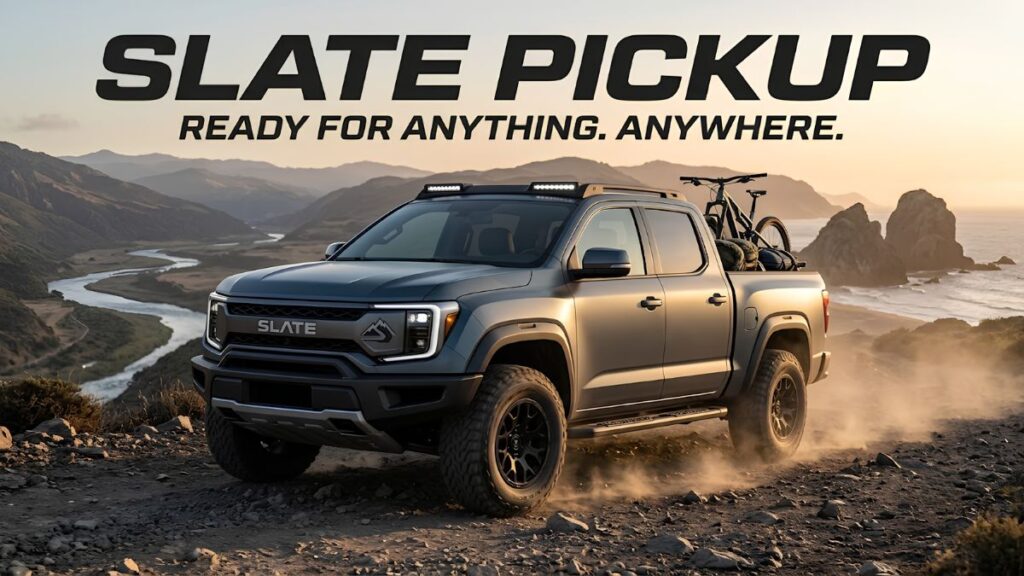
The Slate pickup truck is one of the most unusual new vehicles coming to the U.S. market. Built by startup automaker Slate Auto, the small electric pickup takes a very different approach from traditional trucks.
Instead of offering multiple trims loaded with technology, Slate starts with a simple two-seat electric pickup and lets buyers customize it with accessories and conversion kits.
The result is a compact rear-wheel-drive electric truck with a starting price of $24,950 before destination, taxes, registration and other fees.
Slate charges a $1,450 destination fee, bringing the price of the truck and destination charge to $26,400 before other applicable costs.
The current truck has a projected 205-mile range, approximately 1,550 pounds of payload capacity and 2,000 pounds of towing capacity.
It uses a single rear-mounted electric motor and a 65-kWh battery pack.
The Slate is not intended to compete directly with full-size pickups such as the Ford F-150, Chevrolet Silverado 1500 or Ram 1500. It is much smaller and is aimed at buyers who want inexpensive transportation with useful pickup capability.
Its closest conventional competitor is arguably the Ford Maverick, although the Slate is significantly more minimalist and is fully electric.
Slate Pickup Price
The Slate Truck starts at $24,950 for the Blank Slate configuration.
The price excludes the $1,450 destination charge, taxes, title, license, registration, government fees, documentation fees and optional accessories. Slate says the $1,450 destination fee is the same for every Slate.
That makes the basic truck cost $26,400 including destination before taxes and other charges.
Slate also uses a direct-to-consumer sales model rather than a traditional dealership system.
The company currently requires a $300 preorder deposit, which counts toward the final purchase price.
Slate Truck pricing
| Configuration | Starting price |
|---|---|
| Blank Slate Truck | $24,950 |
| Destination | $1,450 |
| Truck + destination | $26,400 |
| Five-seat Squareback SUV | From $29,950 |
| Five-seat Fastback SUV | From $31,950 |
The SUV prices are separate configurations based on the same underlying vehicle platform.
The most important number for pickup buyers is the $24,950 starting price because that is the price of the basic two-seat truck.
Optional accessories can increase the final cost considerably.
What Is the Slate Pickup Truck?
The Slate Truck is a small electric pickup with a two-door, two-seat configuration.
The company designed it around a modular platform that can be customized after purchase.
The same vehicle can be transformed into a five-seat SUV using conversion components.
Slate’s basic philosophy is that buyers should not have to pay for equipment they do not need.
That explains the truck’s unusual interior.
There is no large central infotainment screen.
Instead, Slate uses a smartphone-based approach with a dashboard phone mount.
The truck also uses physical controls rather than moving most functions onto a touchscreen.
The company describes the Slate as a vehicle that is designed to be customized and maintained by its owners.
That is very different from the direction taken by most modern vehicles.
Slate Pickup Engine and Motor
The Slate does not have a gasoline engine.
It uses a single rear electric motor driving the rear wheels.
Slate’s official specification sheet lists the motor output at 135 kW. Independent automotive specifications commonly convert this to approximately 181 horsepower and 195 lb-ft of torque.
Slate Truck powertrain
| Specification | Slate Truck |
|---|---|
| Powertrain | Electric |
| Motor | Single rear motor |
| Motor output | 135 kW |
| Approx. horsepower | 181 hp |
| Approx. torque | 195 lb-ft |
| Drivetrain | Rear-wheel drive |
| Transmission | Single-speed |
| Claimed 0 to 60 mph | About 8 seconds |
The 181-hp and 195-lb-ft figures are commonly reported specifications, while Slate’s own released specification sheet currently gives the motor output as 135 kW rather than publishing horsepower and torque figures.
The Slate is not intended to be a performance truck.
Its relatively modest output is appropriate for a lightweight, compact pickup designed primarily for everyday transportation and light-duty hauling.
Instant electric torque should also make it feel responsive from a stop.
Slate Pickup Battery
The current Slate Truck uses a single battery configuration.
The battery has approximately 65 kWh of total capacity, with about 63 kWh usable according to current published specifications. The battery uses LFP chemistry.
This is important because Slate originally discussed different battery options.
The company has now consolidated the vehicle around a single battery and a projected range of 205 miles.
Slate says the updated range is approximately 37 percent higher than the original estimate.
The current approach is simpler:
One truck. One battery. One motor. Lots of ways to customize it.
That helps Slate keep the base vehicle relatively inexpensive.
Slate Truck Range
The Slate Truck has a projected range of 205 miles.
There is an important qualification here.
The 205-mile figure is not yet an official EPA-estimated range.
Slate says it is an estimate based on an EPA test cycle, with the official EPA estimate to be provided when available. The vehicle is still in preproduction, so specifications can change.
For city driving and local commuting, 205 miles could be enough for many owners.
For frequent long-distance highway trips, it is much less impressive.
The Slate is therefore better understood as a local-use electric utility vehicle rather than a long-distance road-trip truck.
Slate range compared with larger EVs
The Slate’s range is modest compared with larger electric vehicles.
But its small battery is part of the reason the company can target a starting price below $25,000 before destination.
Slate is essentially making a trade-off:
Less range and equipment in exchange for a much lower purchase price.
For some buyers, that will be a reasonable trade.
Slate Pickup Charging
The Slate Truck uses a NACS charging connector.
This is important because NACS has become the dominant charging connector for new U.S. electric vehicles.
The truck supports home Level 2 charging as well as DC fast charging.
Slate’s current specifications list DC fast charging capability of up to 120 kW.
Independent automotive sources have reported a lower peak charging figure in some preproduction information, so the final production charging curve will be worth watching.
Slate says the truck can charge from approximately 20 percent to 80 percent in around 30 minutes using a suitable DC fast charger.
For an owner who primarily charges at home overnight, charging speed is less important than it is for someone regularly traveling long distances.
Slate Pickup Towing Capacity
The current Slate Truck has a maximum towing capacity of 2,000 pounds.
That is double the original 1,000-pound target Slate discussed earlier in the vehicle’s development.
A 2,000-pound rating is enough for many light-duty applications.
It can make the Slate useful for:
- Small utility trailers
- Motorcycles
- Small recreational equipment
- Landscaping equipment
- Lightweight cargo trailers
- Local hauling
It is not intended for large travel trailers, heavy construction trailers or serious long-distance towing.
Does towing reduce Slate range?
Yes.
As with other electric vehicles, towing adds weight and aerodynamic drag.
The additional load requires more energy from the battery.
That means a Slate pulling a 2,000-pound trailer should not be expected to achieve its normal 205-mile projected range.
For buyers who frequently tow, a larger EV or gasoline pickup with greater towing capacity will make more sense.
Slate Pickup Payload Capacity
The Slate has a maximum projected payload of 1,550 pounds in pickup configuration.
That is an impressive figure considering the truck’s compact size.
It also gives the Slate an interesting advantage over some larger-looking compact pickups.
For example, the current published Slate specification lists 1,550 pounds of pickup payload, while the Ford Maverick’s maximum payload is around 1,500 pounds depending on configuration.
Payload includes passengers and other weight carried by the vehicle, not just cargo in the bed.
That means buyers should always consider the specific configuration and the actual load before reaching the maximum rating.
Slate Truck Bed Size
The Slate has a five-foot pickup bed.
The official specification sheet lists:
- Bed length: 60.5 inches
- Bed length with tailgate down: 80.7 inches
- Minimum bed width between wheel wells: 43.9 inches
- Maximum bed width: 59 inches
- Bed volume: 35.1 cubic feet
- Bed height: 19.5 inches
The five-foot bed gives the Slate genuine pickup usefulness.
It is large enough for many everyday items while keeping the overall truck compact.
There is also a 7-cubic-foot front trunk.
That is particularly useful because the standard Slate has only two seats and no traditional rear passenger area.
Slate Pickup Size
The Slate is much smaller than a typical American pickup.
Its official dimensions are:
| Dimension | Slate Truck |
|---|---|
| Length | 174.6 inches |
| Width without mirrors | 70.6 inches |
| Width with mirrors | 78.1 inches |
| Height | 68.0 inches |
| Wheelbase | 108.9 inches |
| Ground clearance | 7.8 inches |
This is one of the Slate’s biggest advantages for urban buyers.
A 174.6-inch-long truck is considerably easier to park and maneuver than most midsize and full-size pickups.
The 108.9-inch wheelbase is also very short by pickup standards.
The compact dimensions should make the Slate particularly useful in cities and older neighborhoods with tight parking spaces.
Slate Pickup Interior
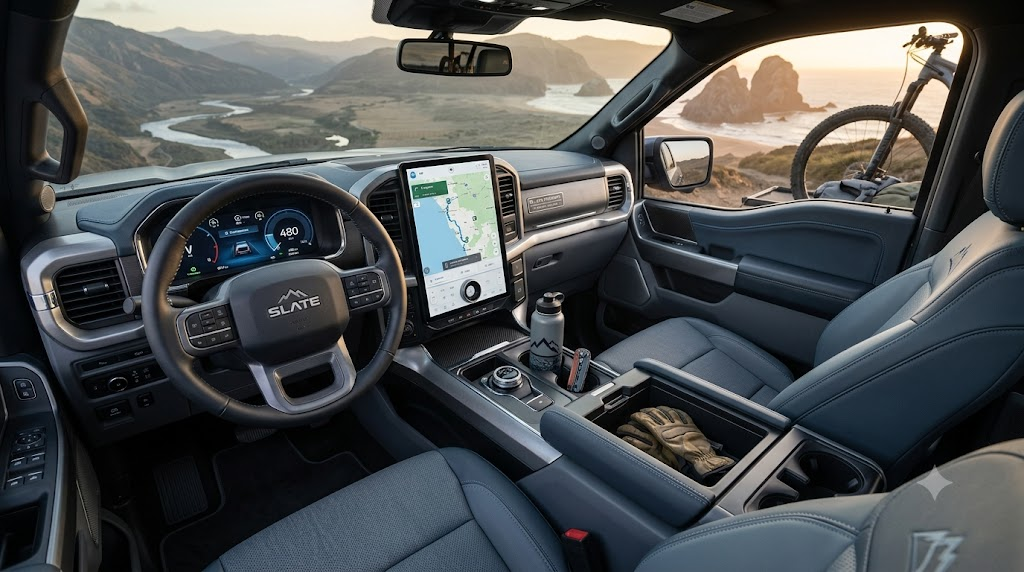
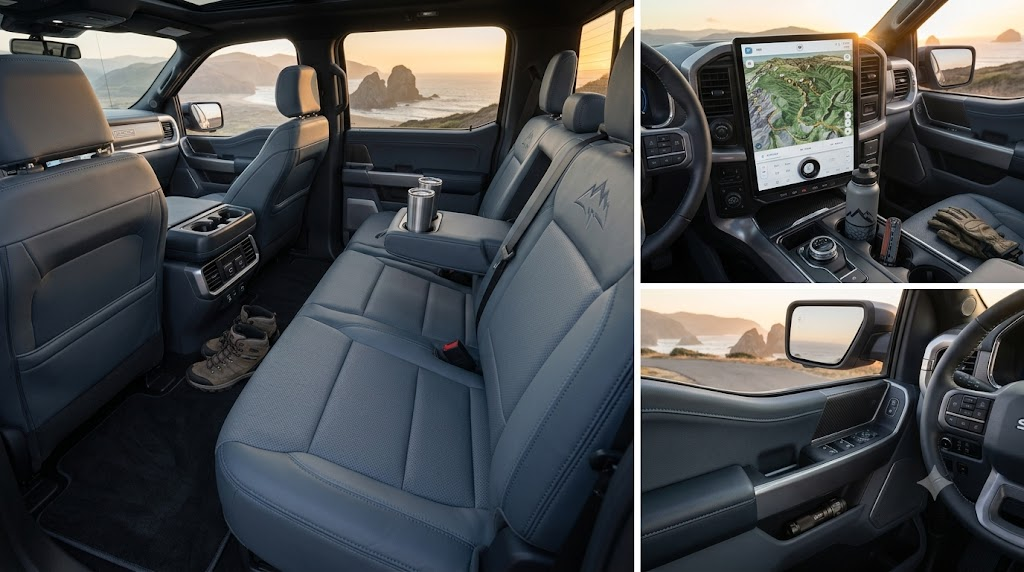
The Slate interior is deliberately basic.
The standard truck comes with manually adjustable seats, a small digital instrument display, physical controls and a dashboard-mounted smartphone holder.
The truck uses crank windows rather than conventional power windows in its basic configuration.
That may sound strange on a new vehicle, but it is a direct result of Slate’s attempt to reduce the number of components and keep the starting price low.
There are no large luxury screens or complicated infotainment systems.
The concept is closer to buying a basic utility vehicle and adding the equipment you want.
For some buyers, that will be refreshing.
For others, it will feel too stripped down.
Why Does the Slate Have No Touchscreen?
The lack of a traditional touchscreen is one of the Slate’s defining decisions.
Instead of installing an expensive infotainment system that becomes outdated over time, Slate expects owners to use their phones.
A smartphone can be mounted on the dashboard and used for navigation, music and other functions.
The company can therefore avoid the cost and complexity associated with a large integrated infotainment system.
This also makes the vehicle easier to update from the owner’s perspective because the phone can be replaced independently.
Slate is essentially applying a smartphone philosophy to the car.
Slate Pickup Design
The Slate has an intentionally simple exterior.
The standard vehicle uses gray composite body panels rather than a conventional collection of expensive painted steel panels.
The body panels use a glass-injected polypropylene composite material.
One claimed advantage is that individual panels can be replaced relatively easily if damaged. Independent reviews of preproduction vehicles have highlighted the panels’ resistance to dents and the ability to replace individual components rather than repair an entire body section.
Slate also expects owners to customize the truck through wraps, wheels, accessories and other parts.
The result is a vehicle that can look very different depending on how the owner builds it.
Slate Pickup Customization
Customization is central to the Slate business model.
Instead of offering traditional trims such as Sport, Limited or Premium, Slate offers a base vehicle and a large accessories marketplace.
Potential accessories include:
- Wheels
- Tires
- Exterior wraps
- Storage systems
- Roof accessories
- Interior upgrades
- Speakers
- Lighting
- Utility equipment
- SUV conversion components
Slate has said that more than 200 accessories are available or planned, with many priced below $500.
This allows the owner to build a basic work truck, lifestyle pickup, adventure vehicle or SUV from the same underlying platform.
Slate Pickup SUV Conversion
The Slate does not have to remain a pickup.
One of its most unusual features is the ability to convert the truck into a five-seat SUV.
Slate offers two main SUV configurations:
Squareback: A more traditional SUV-style design.
Fastback: A sportier configuration with a sloping rear roofline.
The SUV configuration adds rear seats and enclosed cargo space.
The official specification sheet lists:
| Cargo specification | Pickup | SUV |
|---|---|---|
| Passenger capacity | 2 | 5 |
| Payload | 1,550 lb | 1,263 lb |
| Towing | 2,000 lb | 1,824 lb |
| Cargo volume | 35.1 cu ft bed | 34.0 cu ft behind seats |
| Seats folded | N/A | 58.4 cu ft |
The reduction in payload and towing for the SUV comes largely from the additional body and passenger equipment.
This modular concept is one of the Slate’s strongest selling points.
A buyer could start with a pickup and later convert it when family or lifestyle needs change.
Slate Pickup Safety
Slate has designed the truck with a number of modern safety systems.
Current information includes:
- Electronic stability control
- Traction control
- Automatic emergency braking
- Forward collision warning
- Airbags
- Side curtain airbags
- Backup camera
- Pedestrian detection
- Automatic high beams
Slate has also said the truck is designed to achieve a five-star U.S. NCAP safety rating.
However, that should not be confused with an already completed official five-star government crash-test result.
The vehicle remains in preproduction, so buyers should wait for final independent testing before treating a specific safety rating as confirmed.
Slate Pickup Reliability
It is too early to provide a meaningful long-term reliability rating for the Slate.
This is the first production vehicle from a new automaker.
That means there is no long history of customer vehicles from which to judge issues such as battery degradation, suspension durability, electronics reliability or long-term service costs.
The design does have some potentially positive characteristics.
Slate is using a simple single-motor rear-wheel-drive system and relatively few electronic features.
The company also emphasizes repairability and DIY maintenance.
Slate says the vehicle has fewer parts than a typical truck and is designed so owners can perform some maintenance and personalization themselves.
But simplicity does not automatically guarantee reliability.
The biggest reliability question is how well Slate’s manufacturing process performs once large-scale customer production begins.
Slate Pickup Warranty
Slate has announced a 10-year/110,000-mile battery and powertrain warranty.
That is longer than the standard federal minimum battery warranty requirement for EVs.
The warranty is an important consideration because battery replacement can be one of the most expensive potential EV repairs.
Still, warranty length should not be confused with proven long-term reliability.
The Slate is a new vehicle from a new manufacturer, so there is no decade-long ownership history yet.
Slate Pickup Production and Delivery
Slate says the first deliveries are planned for late 2026.
The company has opened preorders, but delivery windows depend on when the buyer places the preorder.
The current preorder page is already displaying July to September 2027 delivery windows for new preorders.
That means there is an important difference between:
First deliveries: expected late 2026
and
A new preorder today: potentially delivered during 2027.
Buyers should not assume that placing a preorder in October 2026 means receiving a truck before the end of 2026.
Slate says delivery timing can change based on production, supply chain, regulatory and logistical factors.
Where Is the Slate Pickup Made?
Slate plans to manufacture the vehicle in Warsaw, Indiana.
The company is developing a manufacturing operation around its U.S. production strategy.
The vehicle itself has been designed and engineered in the United States.
Slate’s approach is therefore not simply to import a finished vehicle into America.
The company is attempting to establish domestic vehicle production.
Slate Pickup vs Ford Maverick
The Ford Maverick is probably the most important comparison for the Slate.
Both are compact pickups intended for buyers who do not need a large truck.
But they approach the market very differently.
The Maverick is a conventional four-door pickup with gasoline and hybrid powertrain choices.
The Slate is a two-seat electric pickup with a modular design.
The Slate has:
- Lower starting price
- Electric powertrain
- Smaller dimensions
- 1,550-lb payload
- 2,000-lb towing
- Modular SUV conversion
- Minimalist interior
The Maverick has:
- Four doors
- Five-seat capacity
- More conventional interior
- Available hybrid powertrain
- More established dealer and service network
- Higher available towing with the appropriate configuration
For a family vehicle, the Maverick is easier to understand.
For someone who wants a simple electric utility vehicle, the Slate is far more distinctive.
Slate Pickup vs Hyundai Santa Cruz
The Hyundai Santa Cruz is another compact pickup alternative.
It offers a four-door cabin, five seats, modern infotainment, available all-wheel drive and a more conventional driving experience.
The Slate is considerably more basic.
It has two seats in pickup form, rear-wheel drive and no conventional touchscreen.
The Santa Cruz is therefore the better choice for buyers who want a normal modern vehicle.
The Slate is aimed at buyers who specifically value low cost and simplicity.
Slate Pickup vs Toyota Tacoma
The Toyota Tacoma is considerably larger and more capable than the Slate.
The Tacoma offers significantly more towing capability, four-wheel-drive configurations and serious off-road versions.
The Slate is not a Tacoma competitor in terms of capability.
Instead, the Slate competes on:
- Price
- Size
- Simplicity
- Electric power
- Customization
A buyer looking for a serious work or off-road pickup should choose the Tacoma or another midsize truck.
A buyer looking for a small electric pickup for local use may find the Slate much more interesting.
Slate Pickup vs Tesla Cybertruck
The Slate and Tesla Cybertruck are both electric pickups, but that is where most of the similarities end.
The Cybertruck is large, expensive and designed around high performance and towing capability.
The Slate is compact, inexpensive and deliberately simple.
The Cybertruck is a technology-heavy EV.
The Slate is almost the opposite.
One is designed to showcase technology.
The other is designed to remove as much unnecessary technology as possible.
Is the Slate Pickup Good for Daily Driving?
It could be.
The compact dimensions should make the Slate easy to drive and park in urban environments.
The rear-wheel-drive electric powertrain should provide smooth acceleration, while the small size should make the truck relatively easy to maneuver.
The biggest limitations are range and the basic interior.
A projected 205-mile range is adequate for many local commuters but is not particularly strong for long highway journeys.
The basic cabin also will not appeal to everyone.
For a buyer who values simplicity, however, these limitations may be acceptable.
Is the Slate Pickup Good for Work?
For light-duty work, the Slate could be useful.
Its 1,550-pound payload rating is particularly impressive.
The five-foot bed provides practical cargo space, and the 7-cubic-foot frunk provides additional storage.
Small businesses could use the truck for:
- Tools
- Gardening
- Landscaping
- Maintenance work
- Local deliveries
- Small equipment
- Building supplies
The biggest limitation is towing.
At 2,000 pounds, the Slate is not intended for heavy trailers.
For serious construction, agriculture or towing work, a larger pickup remains the better choice.
Slate Pickup Pros and Cons
Pros
- $24,950 starting price
- $1,450 destination charge
- Fully electric
- 205-mile projected range
- 1,550-pound pickup payload
- 2,000-pound towing capacity
- Five-foot bed
- 7-cubic-foot frunk
- Compact dimensions
- Rear-wheel drive
- NACS charging
- Simple interior
- Physical controls
- Modular SUV conversion
- Large accessory ecosystem
- Direct-to-consumer sales
- 10-year/110,000-mile battery and powertrain warranty
Cons
- Official EPA range is not yet available
- Still a new manufacturer
- Production is only beginning
- Rear-wheel drive only
- Two seats in pickup configuration
- Very basic standard interior
- No conventional built-in infotainment screen
- Limited towing capacity
- 205-mile range is modest for highway travel
- Final specifications can still change
- New preorder customers may wait until 2027
Is the Slate Pickup Worth Buying?
The Slate Truck is difficult to compare with normal pickups because it is built around a completely different idea.
Most new trucks are becoming larger, more powerful and more expensive.
Slate is moving in the opposite direction.
It is small.
It is simple.
It is electric.
And it starts below $25,000 before destination and other charges.
The current specifications are also more useful than the original concept suggested. The truck now has a projected 205-mile range, 1,550-pound payload and 2,000-pound towing capacity.
The biggest question is whether Slate can successfully deliver the vehicle at scale.
That is particularly important because this is the company’s first production vehicle.
For a buyer who wants a low-cost electric vehicle for commuting, local hauling, DIY work and everyday transportation, the Slate could be genuinely compelling.
For someone who needs a truck for heavy towing, long-distance travel, serious off-roading or family transportation, it is not the right tool.
The most interesting thing about the Slate is therefore not its horsepower.
It is the philosophy behind it.
Buy a simple vehicle first, then make it your own.
That idea could appeal to a large group of buyers who feel that modern vehicles have become too expensive and unnecessarily complicated.
Slate Pickup FAQ
What is the Slate pickup truck?
The Slate Truck is a compact electric pickup from Slate Auto. It starts as a two-seat truck and can be converted into a five-seat SUV.
How much does the Slate pickup cost?
The Blank Slate pickup starts at $24,950 before the $1,450 destination charge, taxes, registration and other fees.
How much does the Slate pickup cost with destination?
The $24,950 starting price plus the $1,450 destination charge equals $26,400 before taxes, registration, documentation fees and options.
Is the Slate pickup really under $25,000?
Yes. The advertised base vehicle price is $24,950. However, destination, taxes, registration, government fees and optional equipment are extra.
How much horsepower does the Slate pickup have?
Slate’s official specification sheet lists the electric motor at 135 kW. Independent automotive specifications convert that output to approximately 181 horsepower.
How much torque does the Slate pickup have?
Independent automotive specifications list approximately 195 lb-ft of torque. Slate’s official released specification sheet currently specifies the motor output in kW rather than publishing a torque figure.
What is the Slate pickup range?
Slate currently projects 205 miles of range for the Blank Slate Truck. This is not yet an official EPA-estimated range.
What battery does the Slate pickup use?
The Slate uses a roughly 65-kWh LFP battery, with approximately 63 kWh usable according to current published specifications.
Does the Slate pickup have AWD?
No. The current Slate Truck uses rear-wheel drive with a single rear electric motor.
How much can the Slate pickup tow?
The Slate pickup has a maximum towing capacity of 2,000 pounds.
What is the Slate pickup payload?
The maximum pickup payload is 1,550 pounds.
How big is the Slate pickup bed?
The bed is approximately five feet long, with 35.1 cubic feet of bed volume. The official specification sheet lists a 60.5-inch bed length with the tailgate closed.
Does the Slate pickup have a frunk?
Yes. The Slate has approximately 7 cubic feet of front-trunk storage.
How big is the Slate pickup?
The truck is 174.6 inches long, 70.6 inches wide without mirrors and 68 inches tall, with a 108.9-inch wheelbase.
Does the Slate pickup have a touchscreen?
No traditional central touchscreen is included in the basic vehicle. Slate instead uses a smartphone-centered approach.
Does the Slate pickup have Apple CarPlay?
The basic Slate does not rely on a conventional built-in infotainment system. It is designed around the owner’s smartphone and optional accessories.
How many people can the Slate pickup seat?
The standard pickup seats two people.
Can the Slate pickup become an SUV?
Yes. Slate offers conversion options that turn the pickup into a five-seat Squareback or Fastback SUV.
How much does the Slate SUV cost?
Slate says the Squareback SUV starts at $29,950 and the Fastback SUV starts at $31,950, before destination and other charges.
When will the Slate pickup be available?
Slate says first deliveries are planned for late 2026.
Can I order a Slate pickup now?
Yes. Preorders are currently open, with a $300 deposit that counts toward the purchase price.
When will a new Slate preorder be delivered?
Current preorder information shows delivery windows extending into July to September 2027 for new orders.
Is the Slate pickup a 2027 model?
The vehicle is commonly described as the 2027 Slate Truck in automotive coverage, although Slate’s own consumer materials generally refer to it simply as the Slate Truck.
Where will the Slate pickup be made?
Slate plans to manufacture the vehicle in Warsaw, Indiana.
Is the Slate pickup reliable?
It is too early to give a definitive reliability rating. Slate is a new automaker and the vehicle has not yet accumulated years of customer ownership data.
What warranty does the Slate pickup have?
Slate says its battery and powertrain are covered for 10 years or 110,000 miles.
Is the Slate pickup good for towing?
It is suitable for light towing, with a 2,000-pound maximum rating. It is not intended for heavy trailers or long-distance towing.
Is the Slate pickup good for daily driving?
It could be a good daily driver for someone who primarily drives locally and accepts its 205-mile projected range and minimalist interior.
Is the Slate pickup better than the Ford Maverick?
Neither is universally better. The Maverick is a more conventional four-door pickup with gasoline and hybrid options. The Slate is smaller, electric and much more minimalist.
Is the Slate pickup cheaper than the Ford Maverick?
The Slate’s $24,950 base price is very aggressive and places it below many new pickups, although equipment levels are very different.
Is the Slate pickup good for families?
The standard pickup is not ideal for families because it only has two seats. The five-seat SUV conversion makes the platform much more practical for family use.
Is the Slate pickup worth buying?
It could be a compelling option for buyers who want a low-cost electric vehicle with a useful pickup bed, but buyers should understand that it is a first-generation vehicle from a new manufacturer and that final EPA figures and production specifications are still pending.